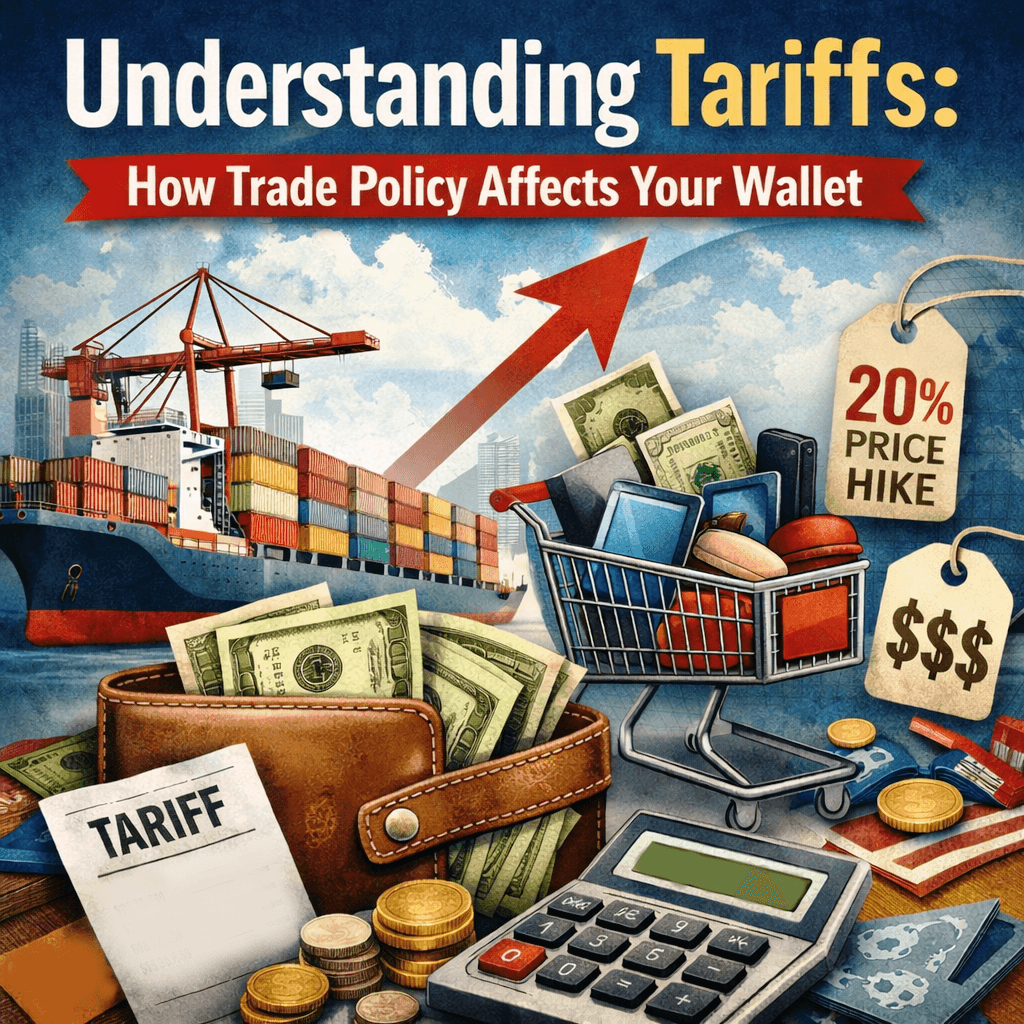
Tariffs aren’t just abstract numbers tossed about in political speeches. They are taxes on imported goods that ultimately influence the prices we pay for everyday items and the health of the broader economy. With a resurgence of tariff‐heavy policies in 2025 that disrupted decades of declining trade barriers, it’s crucial to understand what tariffs are, why governments use them and how they affect your wallet.
What Are Tariffs?
Economists define a tariff as a tax imposed on goods imported from another country. When a product crosses a border, the importing company pays this duty to its home government. Tariffs can be levied in different ways:
- Ad valorem tariffs charge a fixed percentage of the good’s value, such as a 25 % duty on an imported washing machine.
- Specific tariffs add a fixed dollar amount per unit (for example, $2 per pair of shoes).
- Tariff‐rate quotas allow a certain quantity to enter at a low rate and impose higher rates after the quota is met.
Although tariffs were once a major source of government revenue in the United States, the introduction of income taxes and other taxes reduced their fiscal importance. Modern tariffs are primarily used to protect domestic industries, address perceived unfair trade practices and as leverage in international negotiations.
Who Pays the Tariff?
A common misconception is that foreign companies pay tariffs. In reality, importers pay duties when goods arrive. Whether the importer absorbs the cost or passes it along depends on market conditions, but many studies find that the costs are often passed to domestic consumers. For goods with low profit margins, retail goods, electronics or clothing, and importers raise prices to maintain margins, so consumers ultimately bear much of the burden. Economists at the Council on Foreign Relations note that U.S. consumers have “borne the brunt” of tariffs on Chinese goods through higher prices.
A Brief History of Tariff Trends
Global tariff rates declined steadily after World War II as countries embraced free trade. Updated data from Feenstra and Taylor show that average world tariff rates fell from the 1960s through 2024. U.S. tariffs followed a similar downward trend until a sharp reversal in 2025, when new import duties significantly raised the average effective tariff rate. The Budget Lab at Yale documents that the actual average tariff rate jumped from 2.4 % at the start of 2025 to around 10 % by June and likely 11.5 % by August, the highest since the early 1930s.
The new tariffs generated significant revenue roughly $88 billion through August 2025, but they also triggered a debate about their economic costs. Brookings scholars argue that tariffs are a “particularly bad way to raise revenue” because they distort economic behavior, reduce trade and lead consumers and businesses to pay more for imports.
Why Governments Use Tariffs
Tariffs serve several political and economic purposes:
- Protecting domestic industries and jobs. Tariffs make foreign goods more expensive, giving domestic firms a price advantage. This can help industries that struggle against cheaper imports and potentially preserve jobs. For example, U.S. steel tariffs were intended to protect domestic steel makers but simultaneously raised costs for car and construction industries.
- Correcting perceived unfair trade practices. Governments may impose tariffs in response to allegations of dumping, intellectual property theft or subsidies that give foreign firms an advantage. Recent U.S. tariffs targeted Chinese electric vehicles and other goods, citing concerns about fentanyl trafficking and national security.
- Reducing trade deficits. Some policymakers believe tariffs can reduce imports and shrink trade deficits. While tariffs do discourage imports, they also tend to reduce exports if trading partners retaliate.
- Generating revenue. Though less significant in modern times, tariffs still produce revenue. The Budget Lab estimates that new U.S. tariffs added about $23 billion in August 2025 alone.
How Tariffs Influence the Economy
1. Initial Demand Effects: Unemployment Up, Inflation Down
Empirical analysis from the Federal Reserve Bank of San Francisco examines how changes in tariff rates influence economic variables over time. The authors find that immediately after tariffs rise, unemployment increases and inflation falls. This pattern suggests that higher tariffs act like a negative demand shock: consumers and businesses reduce spending as imported goods become more expensive, which slows economic activity and temporarily reduces inflation. In their sample of advanced economies, a 1 percentage point increase in tariffs raises the unemployment rate by roughly 0.1 percentage points in the first year and lowers inflation by about 0.1 percentage points.
However, these effects don’t last. After two years, the unemployment rate returns to its prior level and inflation starts to rise above the pre‑tariff path. The researchers conclude that tariffs dampen demand in the short run but act as a supply shock in the long run because firms face higher input costs, prompting them to raise prices.
2. Long‑Run Inflation and Supply‑Side Effects
Higher tariffs raise the price of imported intermediate goods used in manufacturing, machinery, electronics or steel. When firms pay more for inputs, they eventually pass on those costs to consumers, increasing inflation over time. Cavallo and colleagues at Harvard, using daily price data from major retailers, estimate that tariffs added about 0.7 percentage points to the U.S. Consumer Price Index by September 2025. They note that retail prices of imported goods rose roughly 5.4 % while domestic goods increased 3 % relative to pre‑tariff trends. This suggests tariffs raise prices across the board, not just for imported items.
According to the Council on Foreign Relations, importers and domestic producers often share the burden: when tariffs raise prices for foreign competitors, domestic producers can safely raise their own prices, further escalating costs for consumers. The Budget Lab similarly finds that 61 to 80 % of the new 2025 tariffs were passed through to consumer goods prices in June, indicating that consumers bear most of the cost.
3. Growth and Productivity
Tariffs reduce the gains from trade by making imports more expensive and discouraging specialization. Brookings scholars argue that tariffs distort the economy by reducing imports, forcing firms to shift to less efficient suppliers and encouraging domestic production of goods better produced abroad. This leads to productivity losses, as industries become more productive when opened to trade.
Research cited by Brookings shows that even small increases in tariffs can reduce GDP. A study by Furceri et al. finds that a 3.6 percentage point tariff increase lowers output by 0.4 percentage points, implying that a 10 % tariff could cut GDP by about 1.1 % over time. The International Monetary Fund estimates that a universal 10 % rise in U.S. tariffs, combined with retaliation from Europe and China, could reduce U.S. GDP by 1 % and global GDP by 0.5 % through 2026. These findings underscore that tariffs are not free: they can shrink the economy and worsen public finances despite generating revenue.
4. Business Confidence and Investment
Trade policy uncertainty can rattle business confidence. J.P. Morgan reports that U.S. service sector sentiment and homebuilder confidence declined in early 2025 amid concerns that broad tariffs might be enacted. Senior economists at the bank note that tariffs are taxes on imports and the tax incidence “nearly always falls on domestic sellers and consumers, and not foreign producers”. During the 2018 to 19 trade war, Chinese exporters did not cut prices significantly; instead, import prices rose almost one for one with the tariffs, passing costs to U.S. consumers.
Uncertainty over future tariffs also disrupts supply chains. Firms hesitate to invest in cross‑border supply chains or stock up on goods if they fear abrupt policy changes. The Budget Lab observes that real U.S. imports surged after tariff announcements as businesses sought to beat the tariff deadline and then plunged after the duties took effect, leaving imports 7 % below trend as of June 2025.
How Tariffs Affect Your Wallet
The most tangible impact of tariffs is on the prices you pay for products and services. Here’s how they can affect your wallet:
1. Higher Prices for Imported and Domestic Goods
Tariffs directly raise the price of imported goods. For example, Cavallo’s research finds that imported goods tracked at five major U.S. retailers became 5.4 % more expensive after tariffs were announced, while domestic goods rose 3 % because domestic producers raised their prices too. Another Harvard Business School analysis reports that imported goods were 6.6 % more expensive and domestic goods 3.8 % more expensive compared to pre‑tariff deflationary trends. Tariffs also increased the all‑items CPI by around 0.7 %. These changes may seem small, but when applied across billions of dollars in household spending, they significantly erode purchasing power.
2. Limited Choices
As tariffs make imports more expensive, some companies stop bringing certain products into a country. Shapiro, a logistics and customs firm, notes that tariffs can limit consumer choices because higher import costs discourage companies from stocking a wide range of goods. Over time, markets may offer fewer imported options, reducing competition and potentially leading to higher prices from domestic producers.
3. Ripple Effects on Wages and Employment
While proponents argue that tariffs protect domestic jobs, research shows mixed results. The Budget Lab finds that tariff‑sensitive employment grew slightly in 2025 but less than expected. Tariff‑sensitive manufacturing employment actually fell slightly year‑to‑date. The Council on Foreign Relations cites a 2020 study showing that tariffs on steel and aluminum resulted in 75,000 fewer jobs in steel‑using industries while creating only about 1,000 jobs in steel production. Tariffs can also provoke retaliatory duties from trading partners, harming export industries like agriculture and manufacturing.
For consumers, job losses or slower wage growth can compound the pain of higher prices. When industries reliant on imported inputs cut production or reduce investment, they may lay off workers or slow hiring, which affects household income. At the same time, inflation erodes real wages, reducing purchasing power.
4. Unequal Impact Across Households
Price increases hit households differently. Harvard Business School faculty member Jaya Wen notes that poorer and middle‑class households take a bigger hit because they spend more of their income on goods. Food, clothing and household items become more expensive, squeezing budgets and widening inequality. Wealthier households are better able to absorb these costs.
5. Housing Costs and Energy
Tariffs on intermediate goods can also raise housing costs. The National Association of Home Builders estimated that about 7 % of home‑building materials were imported in 2024, and tariffs on lumber and other supplies threaten to raise home prices by nearly $8,900 on average. Similarly, tariffs on steel increase the costs of automobiles and construction equipment, which can translate into higher costs for consumers and businesses that rely on these goods.
The Debate Over Tariff Benefits
Tariffs have winners and losers. Supporters argue that they protect jobs and encourage domestic production, while critics highlight their broad economic costs.
1. Arguments in Favor of Tariffs
- Safeguarding industries and jobs: Tariffs can support sectors threatened by cheaper imports, preserving domestic employment.
- National security and strategic supply chains: Governments may impose tariffs to ensure that critical goods (e.g., semiconductors, defense equipment) are produced domestically. Proponents say this reduces dependence on foreign suppliers.
- Bargaining tool: Tariffs can be used as leverage in trade negotiations to induce other countries to change policies considered unfair.
2. Criticisms of Tariffs
- Higher consumer prices: Numerous studies show that importers and consumers pay most of the tariff costs. Estimates from the Budget Lab indicate that consumers bore roughly two‑thirds of the cost of 2025 tariffs. Research from Goldman Sachs cited in Harvard’s analysis projects that consumers could be paying 70 % of tariff costs by 2026.
- Economic inefficiency: Brookings notes that tariffs create distortions by making imports more expensive and encouraging domestic production where the U.S. is not globally competitive. Firms may switch to more costly suppliers to avoid high tariffs.
- Reduced economic growth: In addition to raising consumer prices, tariffs can reduce GDP. Studies estimate that a 10 % tariff could shrink U.S. GDP by about 1.1 % and global GDP by about 0.5 %.
- Retaliation and trade wars: Tariffs often invite retaliatory duties from other countries. Such tit‑for‑tat measures reduce exports, hurt farmers and manufacturers, and create uncertainty that hampers investment..
- Long‑term persistence: Once tariffs are imposed, industries often lobby to keep them. The 1964 “chicken tax” on pickup trucks remains in place decades later because domestic producers benefit.
Managing Tariff Impact: Tips for Consumers and Businesses
While individuals cannot directly set trade policy, they can take steps to adapt to a tariff‑heavy environment:
- Stay informed. Monitor news on trade policy and understand which goods are subject to tariffs. This helps you anticipate price changes and plan purchases. Shapiro stresses the importance of being informed to make smarter buying decisions.
- Support local producers. Buying domestically produced goods when feasible can sometimes offset price increases caused by tariffs. However, remember that even domestic products may become more expensive because they use imported inputs.
- Plan major purchases. If you know tariffs may increase prices of certain items, consider purchasing before the tariffs take effect or exploring alternative brands and suppliers.
- Advocate for balanced trade policy. Participate in civic discussions and contact representatives to express views on trade policy. Informed voters can influence policymakers to consider both economic and consumer impacts when crafting tariffs.
For businesses, managing supply chains becomes even more important:
- Diversify suppliers. Companies dependent on imports should diversify sources to countries with lower tariffs or seek domestic alternatives. However, shifting supply chains takes time and investment.
- Monitor input costs. Businesses should track tariff announcements and adjust inventory levels accordingly to hedge against sudden cost increases.
- Engage in trade advocacy. Industry groups often lobby for exemptions or reductions in tariffs. Active participation can help shape policies that minimise harm.
Conclusion
Tariffs are powerful tools that can protect industries, signal political resolve and raise government revenue, but their costs are often hidden. Modern research overwhelmingly shows that consumers bear most of the burden through higher prices. Initial demand effects may temporarily suppress inflation and employment, but over time supply‑side pressures raise prices and erode purchasing power. Tariffs also reduce trade, distort investment and lower economic growth. Low‑ and middle‑income households feel the effects most strongly.
As trade policy debates intensify in the wake of recent tariff increases, understanding how tariffs work and their consequences is essential. Whether you support protecting domestic industries or favour free trade, it is vital to recognise the link between trade policy and the prices you pay. In a globalised economy, barriers at the border inevitably ripple through supply chains and household budgets. Staying informed, advocating for balanced policies and making thoughtful consumer choices can help mitigate the effects on your wallet and ensure that trade policy serves the broader public interest rather than narrow political goals.
Frequently Asked Questions
What is a tariff in simple terms?
A tariff is a tax a government applies to imported goods. The importing business pays it at the border, and the cost often gets passed along through the supply chain.
Who actually pays tariffs: foreign countries or consumers?
Importers pay tariffs to their home government, but most economists find that a large share of the cost is passed on to consumers through higher prices (especially in low-margin sectors like retail).
Why do governments use tariffs?
Common reasons include protecting domestic industries, raising revenue, responding to alleged unfair trade practices, and using trade pressure as a negotiating tool.
How do tariffs raise prices at the store?
If an imported product (or an imported component used in a product) becomes more expensive because of a tariff, companies may raise prices to protect margins. Even domestic competitors may raise prices when imports get pricier.
Do tariffs only affect imported goods?
No. Prices for domestic goods can rise too because domestic firms face less price pressure from now more-expensive imports, and because many “domestic” products still use imported parts and materials.
Do tariffs increase inflation?
They can. Research tracking large sets of retail goods prices has found tariff-related increases big enough to measurably affect inflation in 2025.
If tariffs raise government revenue, why are they controversial?
Because tariffs can distort buying and sourcing decisions, reduce trade, and impose costs on households and businesses. Many economists argue they are an inefficient way to raise revenue compared with broader tax tools.
Do tariffs help domestic jobs?
Results are mixed. While some protected industries may benefit, other industries that use tariffed inputs can face higher costs and reduced competitiveness. Some studies highlight job losses in “downstream” industries that use the protected materials.
Are tariffs the same as sales tax or VAT?
They’re both taxes, but they apply at different points. A sales tax/VAT applies at the point of sale (or across value-added stages). A tariff applies when goods cross the border and is paid by importers.