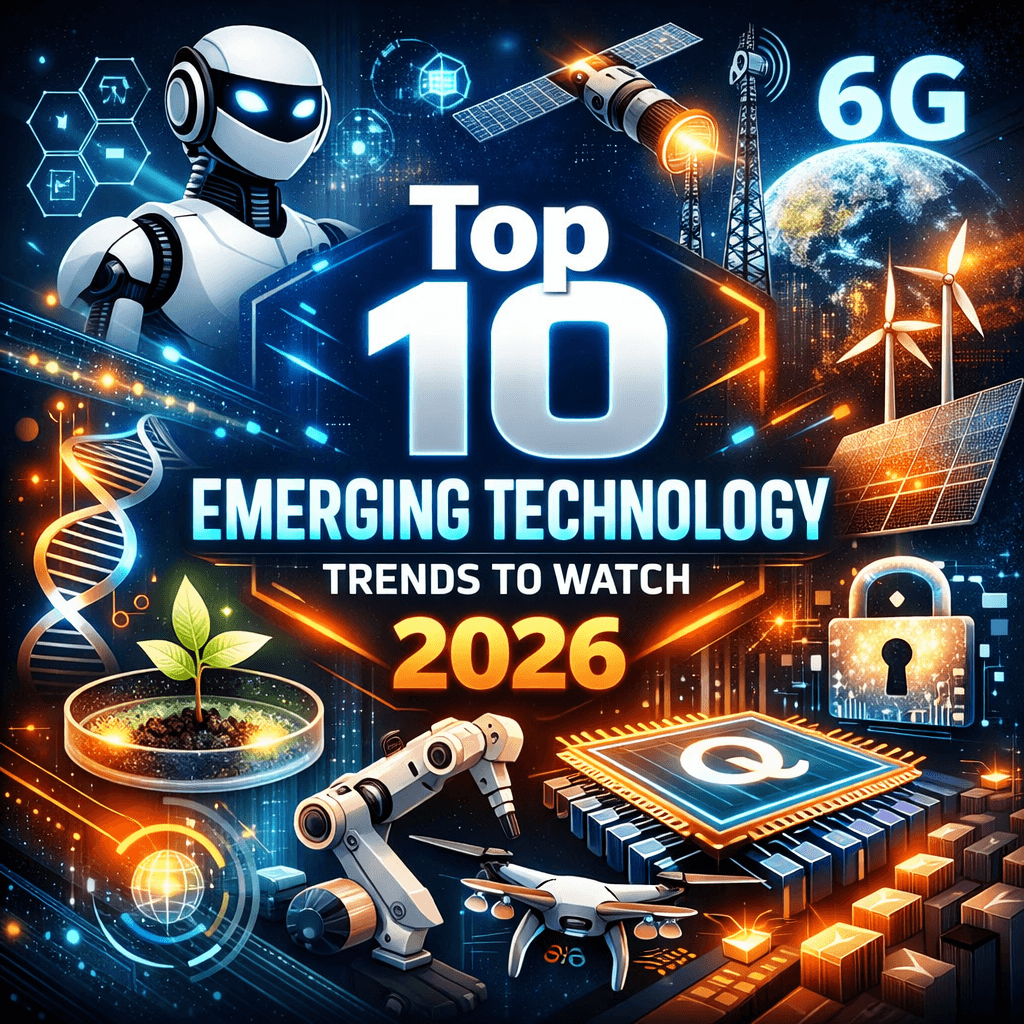
The year 2026 promises to be pivotal for technology. We are moving past experimentation into a period where innovations must deliver tangible value. Analysts from Gartner, ABI Research, Microsoft and other research houses highlight themes around generative AI, quantum computing, cybersecurity and sustainability. This article synthesizes the most consequential trends based on late‑2025 early‑2026 research and forecasts, with citations to credible sources. Each section explains why a trend matters and how it may affect businesses and society.
1. AI‑native development & domain‑specific models
Generative AI is evolving from a novelty into an engine of productivity. Gartner calls AI‑native development platforms a top trend because they empower small teams to build software with generative AI faster and more flexibly. Meanwhile, domain‑specific language models (DSLMs) train on specialized datasets to deliver accurate, relevant results for particular industries; they bridge the gap between generic large language models and real‑world enterprise needs. ABI Research notes that open standards for AI infrastructure will become foundational, making data centers modular and interoperable.
Why it matters
- Accelerated software development: AI‑native platforms use generative models to produce code, documentation and test cases, enabling small teams to build complex applications quickly.
- Enterprise‑grade accuracy: DSLMs understand a domain’s terminology and regulatory context, offering higher precision and stronger governance than generic models. This enables sectors such as finance, law, healthcare or compliance to adopt AI more confidently.
- Modular AI infrastructure: Open standards such as the Open Compute Project and Ultra Accelerator Link make it easier to assemble AI clusters with components from multiple vendors. Vendors that ignore this shift risk exclusion from the next generation of AI customers.
- Human AI teaming: Microsoft notes that AI agents will act as digital coworkers in 2026. A small team could launch a global campaign, with AI handling data analysis and content generation while humans provide strategy. This underscores the need for training employees to work alongside AI rather than competing with it.
2. Multiagent systems & agentic AI
Moving from single‑model solutions toward multiagent systems is another Gartner trend. These systems allow modular AI agents to collaborate on complex tasks. ABI Research calls this concept agentic AI and notes that it will remain mostly in pilot mode in 2026; industries such as telecoms and manufacturing will experiment with agents that recommend actions but avoid full autonomy.
Why it matters
- Complex workflow automation: By dividing a problem into specialized agents, organizations can reuse proven solutions and scale across distributed environments.
- Security & governance: As agents join the workforce, Microsoft stresses that each must have a clear identity with defined access privileges and built‑in security measures to prevent “double agents” that could be exploited.
- Gradual adoption: ABI Research expects agentic AI adoption to remain limited, advising vendors to focus on low‑risk, repeatable tasks rather than full workflow autonomy.
3. Physical AI, robotics & autonomous machines
Physical AI refers to bringing AI into the physical world like robots, drones and smart machines that sense, decide and act autonomously. Gartner lists physical AI as a strategic trend, and ABI Research predicts a surge in productization as partnerships between robotics startups and system integrators create market‑ready solutions.
Why it matters
- Operational efficiency and safety: Physical AI improves efficiency and safety in sectors like manufacturing, logistics and infrastructure. For example, AI‑enabled drones can inspect pipelines or warehouses, reducing the need for risky human labor.
- New skill sets: This trend creates demand for interdisciplinary expertise that bridges IT and engineering. Training programs must prepare workers to collaborate with and maintain intelligent machines.
- Industry partnerships: ABI Research notes that robotics startups are partnering with major system integrators to develop solutions for life sciences, hospitality, retail and healthcare.
- Synthetic data & edge AI: Advances in training data generation and edge processing are reducing time‑to‑market for physical AI products.
4. Preemptive cybersecurity & AI security platforms
Digital threats are escalating. Gartner highlights preemptive cybersecurity, which shifts defense from reactive to proactive by using AI to block threats before they strike. AI security platforms provide centralized visibility across all AI systems and protect against attacks like prompt injection and data leakage. Thriveon notes that threat actors are also using AI to scale attacks, making cybersecurity a board‑level concern.
Why it matters
- Proactive defense: AI‑powered analytics can identify anomalies and predict attacks before they happen. By 2030, preemptive solutions could account for half of all cybersecurity spending.
- Centralized control: AI security platforms unify governance across third‑party and custom AI applications, helping enterprises manage AI‑specific risks like model theft or rogue agents.
- Zero‑trust architecture: Thriveon highlights the growing adoption of zero‑trust frameworks and the integration of cyber resilience into business continuity plans.
- Compliance drivers: The EU’s Cyber Resilience Act will require manufacturers to report vulnerabilities by September 2026, forcing device makers to embed security early in the product lifecycle.
5. Digital provenance & data trust
With AI generating text, images and code at scale, verifying authenticity becomes critical. Gartner’s digital provenance trend calls for technologies that can verify the origin and integrity of software, data and AI‑generated content. Gartner warns that organizations not investing in digital provenance could face compliance risks potentially worth billions.
Why it matters
- Authentication & copyright: Provenance systems use attestation databases, watermarks and software bills of materials to track who created what and when. This helps protect intellectual property and combat deepfakes.
- Regulatory compliance: Governments worldwide are introducing rules requiring organizations to maintain auditable records of their AI models and data sources. Failing to invest in provenance could expose companies to sanctions.
- Public trust: Verifiable origins build trust in AI‑generated outputs. Consumers and regulators will demand transparency about whether content or software was produced by AI or humans.
6. Cloud sovereignty, geopatriation & sustainable data centers
Cloud adoption is maturing into a strategic platform. ABI Research predicts that enterprises will demand cloud sovereignty, seeking full transparency and control across the stack. Gartner adds geopatriation shifting workloads to sovereign or regional clouds to mitigate geopolitical risk. Thriveon highlights multi‑cloud and hybrid infrastructures, with edge computing complementing cloud systems.
Why it matters
- Regulatory & geopolitical pressures: Cloud sovereignty addresses concerns about data residency, platform risk and geopolitical tension. Enterprises will evaluate providers based on transparency and contractual guarantees.
- Regionalization: Geopatriation reduces dependency on foreign providers and aligns with local regulations. By 2030, over 75 % of European and Middle Eastern enterprises may move workloads to regional infrastructures.
- Hybrid & edge computing: Multi‑cloud and hybrid setups offer flexibility and redundancy, while edge computing supports real‑time data processing for latency‑sensitive applications.
- Sustainable infrastructure: Green IT practices such as energy‑efficient data centers and modular AI clusters help reduce the carbon footprint. Open standards for AI data centers enable modular upgrades without waste.
7. 6G, LEO satellites & edge connectivity
Connectivity is evolving. ABI Research observes that initial 6G deployments will focus on practical enhancements, combining 5G‑Advanced with early 6G features like integrated sensing and AI‑driven orchestration. Airlines are rolling out in‑flight Wi‑Fi powered by low‑earth‑orbit (LEO) satellites. Despite 5G hype, LTE will still account for 93 % of cellular IoT module shipments in 2026. Thriveon notes the rise of alternative connectivity solutions, including satellite internet, 5G and 6G.
Why it matters
- Incremental 6G rollout: Early 6G deployments will emphasize realistic use cases rather than hype, focusing on industrial automation and immersive extended‑reality applications.
- LEO satellite networks: High‑speed LEO backhaul transforms passenger experience by providing fast, low‑latency in‑flight connectivity. Vendors should move quickly to support airline rollouts.
- IoT connectivity: LTE remains the dominant technology for IoT modules because it balances cost, performance and power efficiency. Semiconductors and OEMs must continue supporting LTE devices until 5G RedCap becomes cost‑competitive.
- Geopolitical connectivity: Countries are localizing tech infrastructure to reduce dependency on foreign providers and mitigate geopolitical risk. This ties back to the cloud geopatriation trend.
8. AI quantum convergence and quantum computing
Quantum computing is transitioning from theoretical experiments to operational reality. Microsoft predicts that the next leap in computing is near; hybrid systems combining quantum, AI and supercomputers will start tackling problems classical computers can’t solve. ET Edge Insights argues that 2026 will be the breakthrough year for AI quantum convergence through AI and quantum technologies operating as a mutually reinforcing stack. Improvements in hardware fidelity and AI‑led system optimization are making qubits reliable enough for meaningful workloads.
Why it matters
- Hybrid architectures: AI‑driven automation in quantum compilation, calibration and error correction is making hybrid quantum HPC workflows repeatable. Quantum kernels will be applied where classical systems struggle, such as molecular simulation, stochastic sampling and combinatorial optimization.
- Quantum advantage & industry impact: The convergence promises breakthroughs in materials science, drug discovery and supply‑chain optimization. Microsoft notes that logical qubits grouped together can detect and correct errors, paving the way for machines with millions of qubits on a single chip.
- Post‑quantum security: The same quantum capabilities that accelerate discovery threaten current encryption standards. Experts warn that sophisticated adversaries are conducting “harvest‑now, decrypt‑later” campaigns by stockpiling encrypted data. Enterprises must begin transitioning to post‑quantum cryptography now.
- Data integrity: Trusted data foundations are critical. Poor‑quality data can invalidate quantum‑accelerated results. Unified telemetry across endpoints, cloud and networks will be essential.
9. Gene editing & biotechnology advances
Biotechnology is poised for notable breakthroughs in 2026. CAS identifies root‑focused gene editing in crops like rice, wheat and maize: CRISPR edits target root angle and depth, enabling plants to access deeper moisture and withstand drought. Unlike traditional breeding, gene editing allows precise, rapid development of drought‑resilient cultivars and avoids introducing genes from other species. Field trials of CRISPR‑edited plants are underway, showing increased yields.
Another emerging technology is cell‑free biomanufacturing, where proteins or chemicals are produced on demand without living cells. Modular, freeze‑dried systems enable point‑of‑care production of diagnostics or therapeutics, with applications in healthcare and industrial biocatalysis. CAS notes that advances in reaction compartmentalization and energy regeneration make these systems stable and scalable. Additionally, targeted sodium channel blockers like suzetrigine are bringing opioid‑free pain relief, offering non‑addictive alternatives for moderate to severe pain.
Why it matters
- Climate‑smart agriculture: Gene editing helps crops adapt to climate change, improving yield and water efficiency without the controversy of transgenic GMOs.
- Fast biomanufacturing: Cell‑free systems enable portable, real‑time production of proteins or diagnostics, which can revolutionize vaccine development and emergency response.
- Non‑addictive pain therapies: Targeted sodium channel drugs offer alternatives to opioids, addressing a public‑health crisis.
10. Sustainable technology & self‑healing infrastructure
Sustainability is no longer optional; it is integral to innovation. CAS reports that hybrid perovskite‑silicon solar cells have reached power conversion efficiencies over 34 %, surpassing commercial silicon panels. These tandem cells enable more energy generation per square meter and fit in space‑constrained environments. They build upon existing silicon PV infrastructure, accelerating commercialization. Thriveon notes a surge in green IT practices, renewable energy solutions integrated into smart infrastructure and circular economy models supported by digital tracking.
Another major breakthrough combines IoT sensors with self‑healing materials. Advances in microcapsule engineering allow coatings to release healing agents when damage occurs, sealing breaches within hours. When paired with IoT sensors, these coatings enable predictive maintenance for bridges, pipelines and other infrastructure. Early deployments are already underway, and the technology has potential biomedical applications.
Why it matters
- Energy efficiency & decarbonization: More efficient solar cells and green data centers reduce carbon footprints while lowering operational costs.
- Predictive infrastructure maintenance: Self‑healing materials combined with IoT sensors shift maintenance from reactive repairs to proactive care, extending asset lifespans and improving safety.
- Circular economy & transparency: Digital tracking and analytics support circular business models, driving resource efficiency in manufacturing.
Conclusion
The emerging technology trends for 2026 illustrate a shift from experimentation to execution and accountability. AI‑native development, multiagent systems, physical AI and AI quantum convergence promise unprecedented capabilities, but they also demand robust governance, security and data provenance. Cloud sovereignty, 6G connectivity and geopatriation reflect a world where technology and geopolitics are inseparable. Advances in gene editing, biomanufacturing, renewable energy and self‑healing materials demonstrate that sustainability and life sciences are integral to technological progress. Organizations that invest early in trusted data foundations, proactive cybersecurity and responsible innovation will be best positioned to harness these trends and turn disruption into opportunity in 2026 and beyond.
Frequently Asked Questions
Which trend will impact most industries first?
AI embedded into everyday workflows especially AI agents, AI-native development, and AI-driven analytics is likely to deliver the fastest cross-industry impact (customer support, finance ops, sales enablement, software engineering, compliance).
What is AI-native development and how is it different from “using AI tools”?
AI-native development means building software where generative AI is a core part of the development platform (requirements → code → testing → deployment), not an add-on. It typically changes team structure (smaller teams shipping more), documentation, QA, and governance.
What are multi-agent systems?
Multi-agent systems are networks of specialized AI agents that collaborate to complete complex tasks like a team of digital workers. Instead of one general chatbot doing everything, you have agents for research, planning, execution, monitoring, and security, coordinated through orchestration rules.
What is Physical AI?
Physical AI is AI that senses, decides, and acts in the real world, powering robotics, drones, smart equipment, and autonomous systems. It’s important because it turns AI from “information work” into “operational work” (manufacturing, logistics, inspection, safety).
What is an AI security platform?
An AI security platform centralizes visibility and controls for AI systems that covering threats like prompt injection, data leakage, model misuse, unsafe agent actions, and governance enforcement across both in-house and third-party AI tools.
What are the biggest risks of adopting these technologies too fast?
Common failure modes include:
- weak data governance → inaccurate outputs and compliance incidents
- insecure AI integrations → data leakage or prompt injection
- vendor lock-in → high switching costs
- unclear ROI → pilots that never reach production
- workforce resistance → low adoption and shadow IT
Are AI agents safe to deploy in real operations?
They can be, but only with safeguards:
- strong identity and access controls
- clear permission boundaries (least privilege)
- audit logs and monitoring
- human-in-the-loop approvals for sensitive actions
- secure data handling to prevent leakage or prompt injection