Starting a fitness journey at home is easier than you might think. You don’t need a gym or fancy gear just your body and a bit of space. This article presents a simple workout routine for beginners that anyone of any age can do at home, with no equipment required. We’ll cover a safe dynamic warm-up, a clear 5 day workout schedule, detailed exercise instructions (benefits, form, and tips), and a relaxing cool-down with stretches. Use this bodyweight workout plan to build strength, burn calories, and establish a healthy habit. Remember: consistency is key, so keep going at your own pace and watch your progress grow over time.
Warm-Up Routine
Before any workout, it’s crucial to warm up your muscles and get your heart pumping. A dynamic warm-up increases blood flow, improves flexibility, and prepares your body for exercise. Spend 5 to 10 minutes on easy movements like:
1. Arm Circles
Stand tall and swing your arms in big circles (10 to 15 seconds forward, then backward).
2. Leg Swings
Hold onto a wall and swing one leg forward/backward (15 swings each leg), then side-to-side. This mobilizes your hip joints.
3. Hip Rotations
Rotate your hips in circles (10 each direction) to loosen your lower back and pelvis.
4. Jumping Jacks (or March in Place)
Do 30 to 60 seconds of jacks or marching to raise your heart rate. Jumping jacks use your whole body and quickly elevate heart rate and core temperature, making them an excellent warm-up.
5. High Knees or Butt Kicks
Jog in place, bringing knees up or heels back to your butt, for 30 seconds.
These movements should feel easy and controlled the goal is to prepare, not tire yourself out. By “pregaming” your muscles with similar motions, you’ll help prevent injury and improve your workout performance.
Weekly Workout Plan
To build a routine, follow this day plan. Do each workout on consecutive days and then rest or do light activity on the weekends. Always start each session with the warm-up above and end with the cool-down below. Adjust reps and sets to match your current fitness.
1. Monday – Full Body Workout
Focus on fundamental movements that work your whole body. Perform 2 to 3 sets of each exercise with 60 to 90 seconds rest between sets. For example:
- Bodyweight Squats: 10 reps.
- Push-Ups (or Knee Push-Ups): 5 to 10 reps.
- Walking Lunges: 8 reps per leg.
- Plank: Hold for 20 seconds.
- Jumping Jacks: 30 seconds (as cardio).
2. Tuesday – Lower Body & Core
Target your legs, hips, and lower back/core with these moves. Again do 2 sets of each. Example routine:
- Squats: 12 reps.
- Glute Bridges: 10 reps (lie on back and lift hips).
- Reverse Lunges: 8 reps per leg (step back into lunge).
- Side Plank: 15 seconds each side.
- Calf Raises: 15 reps.
3. Wednesday – Active Recovery / Light Cardio
Use this day for gentle movement. Go for a brisk walk, a light jog, or do low-impact cardio for 20 to 30 minutes. You can also repeat your warm-up moves for 1 to 2 rounds. The goal is to keep moving and help your muscles recover without heavy strain.
4. Thursday – Upper Body & Core
Focus on arms, shoulders, chest, and core. Example:
- Push-Ups (knee or wall push-ups if needed): 6 to 10 reps.
- Superman: 10 reps (lie on your stomach and lift chest and legs off the floor to strengthen your back).
- Plank: 25 seconds.
- Side Plank: 15 seconds each side.
- Doorway Rows (or Bent Rows): 10 reps (use a sturdy doorframe or countertop for support).
5. Friday – Full Body Cardio Circuit
Combine strength and cardio for a fun finish. Do 2 rounds of:
- Bodyweight Squats: 12 reps.
- Push-Ups: 8 reps.
- Walking Lunges: 8 reps per leg.
- Mountain Climbers: 20 seconds (in plank, alternate bringing knees to chest).
- Plank: 30 seconds.
6. Saturday & Sunday: Rest or gentle stretching/ walking
Each workout day, choose a comfortable number of sets and reps, and focus on good form. Over time, gradually increase repetitions or hold times to keep challenging your muscles (this “progressive overload” is key for improvement). For example, if 10 squats feel easy, next week try 12. If a 20 to second plank gets easy, hold 5 seconds longer.
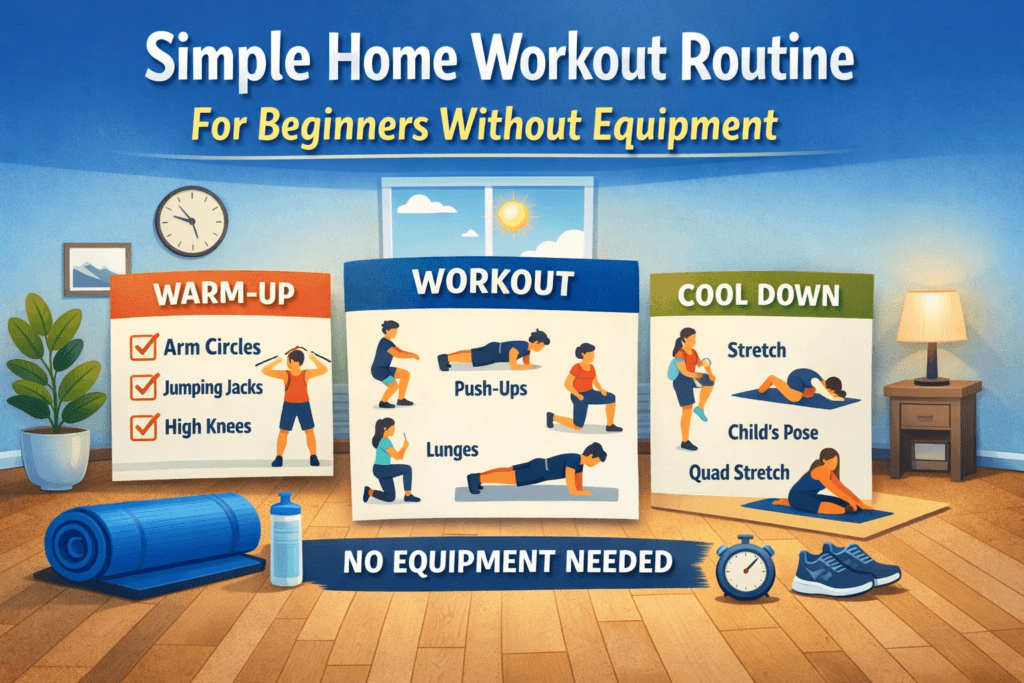
Figure: Example beginner bodyweight workout circuit. This no-equipment routine features squats, push-ups, lunges, a plank, and jumping jacks. Repeat each round 1 to 2 times based on your level (adjust reps as needed).
Cool-Down Routine
After finishing your exercises, cool down to help your body recover. Spend 3 to 5 minutes doing very light movements (slow walking or marching on the spot) to lower your heart rate. Then perform static stretches on the muscles you worked. Hold each stretch gently for about 20 to 30 seconds without bouncing. For example:
1. Hamstring Stretch
Sit and reach toward your toes, or stand and place one heel on a low step, lean forward.
2. Quad Stretch
Stand on one foot, hold your ankle to your butt (hold onto a wall for balance).
3. Calf Stretch
Press your hands against a wall and step one foot back, heel on ground, leaning forward.
4. Chest/Shoulder Stretch
Clasp your hands behind your back and lift gently, or pull one arm across your chest with the other.
5. Child’s Pose / Cat-Cow
Kneel and sit back to stretch your back (child’s pose), or alternate arching and rounding your spine (cat-cow) to relax your spine.
Cool-down stretching is most effective after a workout because your muscles are warm and pliable. These stretches will improve flexibility and reduce stiffness, helping you feel better the next day.
Exercise Descriptions
Below are the key exercises used in this routine. Each entry explains what it does, how to do it correctly, and tips for beginners.
1. Bodyweight Squat
1.1. What It Does
Squats are a powerful lower-body move. They strengthen your quads (front thighs), hamstrings, and glutes, and also engage your core for balance. They improve leg strength and mobility.
1.2. How to Do It
Stand with feet about hip-width apart, toes slightly turned out. Keep your chest up and back neutral. Bend your knees and push your hips back as if sitting on a chair. Go down until your thighs are roughly parallel to the floor (or as low as comfortable), making sure your knees stay aligned over your ankles (don’t let them collapse inward). Then push through your heels to stand back up fully.
1.3. Beginner Tips
Start by squatting to a chair or bench to learn depth and form. Keep weight on your heels. You can hold your arms out in front of you for balance. Go slow on the first reps to feel which muscles activate. If knee pain occurs, don’t squat as low; even a shallow squat can build strength initially.
2. Lunges
2.1. What It Does
Lunges work each leg separately, which builds strength and stability in your thighs (quads and hamstrings), hips, and glutes. They also activate core muscles to keep you balanced.
2.2. How to Do It
Stand upright. For a forward lunge, take a controlled big step forward with one foot. Lower your back knee toward the floor while keeping your front knee above your ankle (not jutting past your toes). Your torso should stay upright. Push through the front heel to step back to start. Alternate legs. For reverse lunges, step backward instead of forward (easier on the knees for some people).
2.3. Beginner Tips
Keep your steps moderate (not too long). If balance is a challenge, do the lunges near a wall or counter to lightly touch for support. Focus on form first: your front knee should track straight ahead, and your back should stay tall. You can do fewer reps per side at first (e.g., 5 to 6 per side) and increase as you get stronger.
3. Push-Up
3.1. What It Does
Push-ups are a classic upper-body exercise. They strengthen your chest (pectorals), shoulders (deltoids), and arms (triceps and biceps), while also engaging your back and core to stay stable. A strong push-up improves overall upper-body strength and helps with everyday pushing movements.
3.2. How to Do It
Start in a high plank position (hands on floor under shoulders, body straight from head to heels). Keep your core tight so your back stays flat. Bend your elbows to lower your chest toward the floor until it’s a few inches above the ground, then push back up to the start. Keep your elbows at about a 45° angle from your body (not flared straight out) to protect your shoulders.
3.3. Beginner Tips
You can modify by doing knee push-ups: drop your knees to the floor, keep a straight line from knees to head, and lower from that position. Or do incline push-ups: place hands on a sturdy chair or countertop, which is easier. Focus on quality over quantity, it’s better to do 5 good push-ups with proper form than 15 sloppy ones. Remember to tighten your core and don’t let your hips sag.
4. Plank
4.1. What It Does
Planking strengthens your entire core. This includes your abs (rectus abdominis), side abs (obliques), and deep abdominal muscles, as well as your glutes and even legs to hold the position. A stronger core improves posture and helps protect your back.
4.2. How to Do It
Get into a push-up position. You can either rest on your forearms (elbows under shoulders) or keep straight arms. Keep your body in one straight line from head to heels, and no sagging hips or raised butt. Squeeze your glutes and pull your belly button in toward your spine. Hold this position for 15 to 30 seconds (or longer if you can).
4.3. Beginner Tips
If a full plank is too hard, start on your knees (keep a straight line from knees to head) and hold. Focus on breathing steadily and keeping tension in your core. Aim to increase your hold time by a few seconds each week. As Cleveland Clinic notes, even a modified plank on knees helps you brace your abs and strengthens core muscles.
5. Side Plank
5.1. What It Does
Side planks target the side of your core (obliques) and the muscles around your hips. They improve balance and strengthen the muscles that stabilize your spine.
5.2. How to Do It
Lie on your side and prop up on one forearm (elbow under shoulder). Stack your feet or stagger them for support. Raise your hips so your body forms a straight line from head to heels. Hold this on one side (15 seconds), then switch to the other side.
5.3. Beginner Tips
You can make it easier by dropping the bottom knee to the floor for support. Keep your top hip aligned over the other. Only hold as long as you can maintain form; even 10 to 15 seconds per side is a good start, then add time gradually.
6. Glute Bridge
6.1. What It Does
The glute bridge works the posterior chain mainly your glutes (buttocks), hamstrings, and lower back. It counteracts many hours of sitting and strengthens the muscles that stabilize your hips and pelvis. Strong glutes also improve balance and can help alleviate lower back discomfort.
6.2. How to Do It
Lie on your back on the floor with knees bent and feet flat on the ground about hip-width apart. Put your arms by your sides. Press through your heels and lift your hips off the floor until your body forms a straight line from shoulders to knees. Squeeze your glutes hard at the top, then lower down slowly.
6.3. Beginner Tips
Make sure you feel the contraction in your glutes and hamstrings, not just your back. If you want more hamstring focus, you can slide your feet a bit further away; for more glute focus, bring feet closer. Try to avoid arching your lower back keep the motion coming from hip extension. Start with 8 to 10 reps and add more as you get comfortable.
7. Jumping Jacks
7.1. What It Does
Jumping jacks are a full-body cardio exercise. They get your heart rate up quickly, warming up your entire body or providing a burst of aerobic exercise. They engage your legs, core, and shoulders simultaneously.
7.2. How to Do It
Stand upright. Jump your feet out wide while raising your arms overhead (forming an X shape). Jump back to the starting position (feet together, arms at sides). Repeat rapidly.
7.3. Beginner Tips
Land softly to protect your joints. If high-impact jacks are too intense at first, do a low-impact version by stepping one foot out at a time instead of jumping. Use jumping jacks as a warm-up or between strength moves to keep your heart rate up. Experts note that jumping jacks “incorporate the whole body” and are excellent for warming up because they elevate heart rate and body temperature.
8. Mountain Climbers
8.1. What It Does
Mountain climbers are a dynamic full-body move that builds core strength and cardio endurance. In one exercise, they work your shoulders, arms, chest, and core (to hold the plank position) while your legs (quads, hamstrings, glutes, and calves) drive the motion. They also raise your heart rate if done continuously.
8.2. How to Do It
Start in a high plank position (hands under shoulders, body straight). Keeping your core tight, bend one knee and bring it toward your chest, then quickly switch legs as if you’re “running” in place in plank. Start slowly to focus on form, then speed up as you get stronger.
8.3. Beginner Tips
Keep your hips level (don’t let the butt shoot up). If this is too challenging, just hold the plank or do “slow mountain climbers” (step one knee in, return it, then the other, at a slow pace). Mountain climbers can be done faster (for cardio) or slower for beginners either way, they reinforce plank position and core stability.
Staying Motivated
Beginning a fitness routine can feel daunting, but the most important part is to start and keep going. Celebrate small wins: each extra rep, longer hold, or additional workout day is progress. Track your workouts in a journal or app, and gradually increase the challenge (e.g., 2 more squats, 5 more seconds of plank) each week, and this progressive overload ensures you continue to improve. Mix up the routine if you like (try different lunge variations or add yoga on a rest day) to keep it interesting.
Remember that consistency beats intensity at first: it’s better to do short workouts 5 days a week than to overdo one day and crash. Find an accountability buddy or join an online beginner group for support and tips. Finally, listen to your body, rest if you feel pain (beyond normal muscle fatigue) and stay hydrated. This simple, no-equipment plan is designed to be safe, effective, and scalable. Stick with it, and you’ll not only get stronger and healthier, but you’ll prove to yourself that you can do more than you thought one workout at a time.
Frequently Asked Questions
Can I really get fit at home without any equipment?
Yes. A consistent home workout for beginners using bodyweight moves (squats, push-ups, lunges, planks) can build strength, improve endurance, and support fat loss. The key is progression over time (more reps, longer holds, slower tempo, shorter rest).
How many days per week should a beginner work out?
A practical starting point is 3 to 5 days per week. If you follow the 5-day plan, keep at least 1 to 2 rest or active recovery days to allow muscles to recover and reduce injury risk.
How long should each workout be?
Most beginners do well with 20 to 35 minutes, including warm-up and cool-down. If you’re short on time, even 10 to 15 minutes can work if done consistently.
Will this help with weight loss?
It can, especially combined with a nutrition plan. Fat loss depends mostly on a calorie deficit; while workouts help you burn calories, maintain muscle, and improve metabolism and fitness.
Do I need to warm up and cool down every time?
Strongly recommended. A warm-up prepares joints and muscles and improves performance. A cool-down helps your body return to baseline and reduces stiffness. Even 5 minutes each makes a difference.
Can I do this routine if I’m older or very out of shape?
Yes, start with the easiest modifications (wall push-ups, assisted squats to a chair, short plank holds). Progress gradually. If you have medical conditions, get clearance from your healthcare provider.
How do I know if I’m doing the exercises correctly?
Use these checkpoints:
- Controlled movement (no rushing)
- Neutral spine (avoid excessive arching)
- Knees track in line with toes (especially on squats/lunges)
- Core braced during planks/push-ups
How do I make the routine harder without equipment?
Progress in simple ways:
- Add reps/sets (e.g., 2 sets → 3 sets)
- Increase time (plank 20s → 30s)
- Slow tempo (3 seconds down, 1 second up)
- Shorten rest periods
- Try harder variations (knee push-up → full push-up)