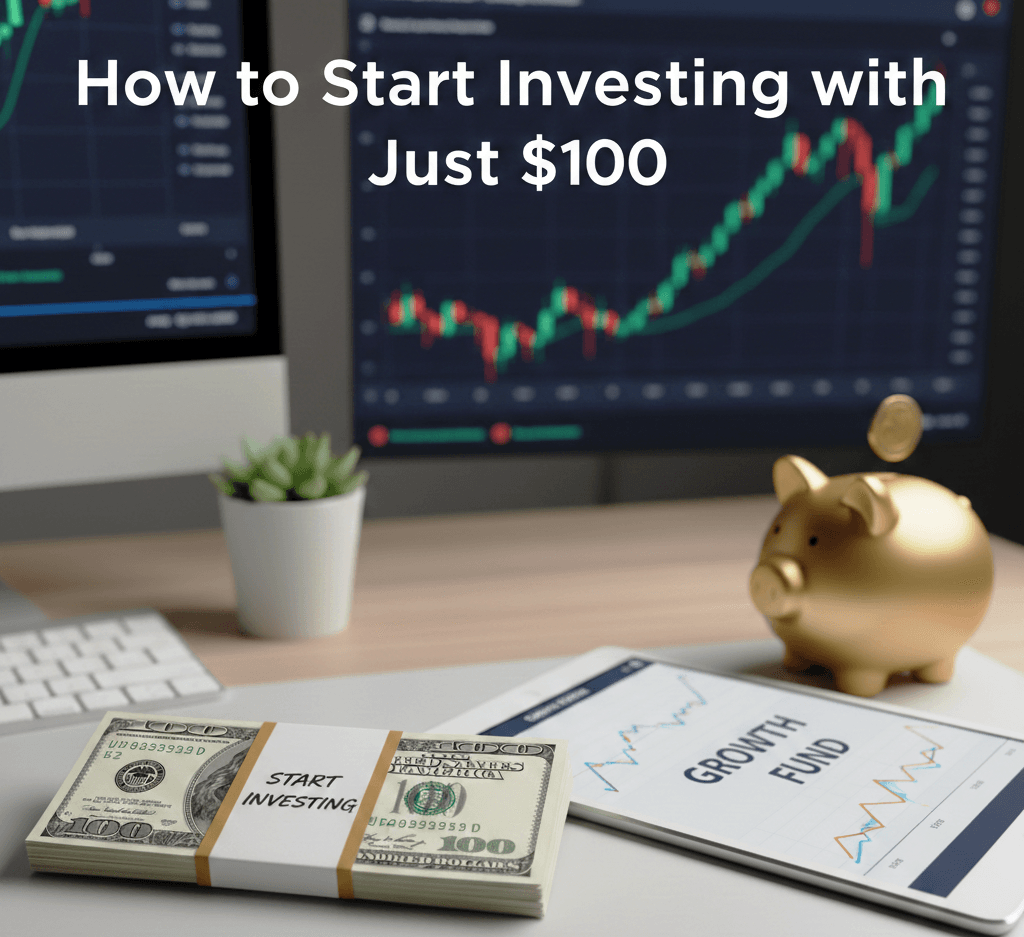
Many people think you need thousands to begin investing. In reality, modern platforms make it possible to start investing today with just $100. Even fractional shares and low-fee index funds let beginners get started small. Over time, that modest $100 can tap into compound growth. This guide will show simple, actionable steps to invest your first $100 with confidence no jargon, just clear tips.
1. Embrace the $100 Mindset
Think of $100 as your first building block, not an obstacle. Starting small allows you to learn without risking much, and consistency can lead to big results. For example, investing $100 every month at a moderate 6% annual return could grow to nearly $98,000 in 30 years. Even one-time $100 investments can grow significantly if you leave them to compound. As one financial planner puts it, “These small amounts accumulated over time can make a difference.” In short, starting small is smart it gets you in the game and begins the power of compound interest at work.
2. Set Goals and Educate Yourself
Before you invest, ask: Why am I investing? Are you saving for retirement 30 years away, a house in five years, or just building general wealth? Defining short-term vs. long-term goals helps choose the right investments. For long-term goals, stocks or index funds make sense; for very short-term needs, you might stick to savings. Most importantly, learn the basics. Many beginners worry they lack knowledge instead of feeling stuck, start with simple steps. Learn key terms (stocks, ETFs, diversification) and fundamental concepts. Read a beginner’s book or watch a quick online tutorial. This financial education will boost your confidence and help you understand risks. Remember, successful investors didn’t learn overnight; they started small and learned as they went.
3. Explore Your Investment Options
With $100, focus on accessible, diversified choices. Here are some beginner-friendly options:
3.1. Low-Cost Index Funds or ETFs
These funds track a market index (like the S&P 500) so your $100 buys a tiny piece of hundreds of companies at once. Index funds are “low-cost, easy way to build wealth,” and you can build a diversified portfolio with just a few of them. Many ETFs have no minimum or very low minimums, so your $100 goes directly to work across a broad market.
3.2. Fractional Shares (Dollar-Based Investing)
Fractional trading lets you buy part of a share based on dollar amount, not whole shares. For example, Vanguard explains that dollar-based investing “lets you invest in a security based on a dollar amount of your choosing… you can purchase fractions of shares”. This means if one share costs $500, your $100 can still buy 0.2 shares. Fractional shares break down the price barrier, so any amount (even $1) can be invested. This is perfect for high-priced stocks or ETFs: every dollar you have can be put to work.
3.3. Robo-Advisors and Micro-Investing Apps
These automated platforms handle the details for you. Apps like Acorns or Stash automatically invest your spare change (rounding up purchases) into diversified portfolios. They often have no or very low minimums and charge a small fee instead of commissions. Robo-advisors use algorithms to pick and rebalance investments based on your risk level great for beginners who want guidance. As NerdWallet notes, micro-investing apps “allow people to safely and responsibly start investing, no matter how little they know about the stock market”. They can be a stress-free way to begin with $100 (or even less).
3.4. High-Yield Savings or Bonds
If your goal is under 5 years, consider a high-yield savings account or short-term bonds. They won’t grow as much, but they protect your $100 from market swings. In general, though, even a bit in a stock/index fund or ETF can beat savings interest over the long run as long as you’re okay with some volatility.
When choosing a platform, look for no-commission brokers or apps with low fees so your whole $100 is invested. Many firms like Fidelity, Schwab, or Vanguard now offer commission-free trades and fractional shares.
4. Stay Consistent with Dollar-Cost Averaging
Consistency is a beginner’s best friend. Instead of trying to time the market, commit to investing regularly. This strategy is called dollar-cost averaging: you put a fixed amount (say, $25 or $50) into your investments every week or month. If prices are high, you buy less; if prices fall, you buy more shares. Over time, this smooths out market ups and downs.
As NerdWallet explains, making regular contributions “can help investors stick to their investment plan and avoid trying to time the market regardless of how much you’re investing.”. Even if you can only add $10 or $20 every week, it builds discipline. Remember Anthony O’Neal’s advice: successful investing isn’t about timing the market or needing a big sum, but about “consistency and commitment.” By starting with $100, you’re already on the path to good habits. Set up automatic transfers to your investment account if possible, so your investing happens without extra thought.
5. Diversify and Manage Risk
Don’t put all your eggs in one basket. With limited funds, you can still diversify. The easiest way is through index funds or ETFs, since they bundle many investments. As NerdWallet notes, “every time you buy a share of an index fund, the amount you invest is distributed across dozens, hundreds or even thousands of companies”. This automatic diversification helps stabilize your portfolio. In fact, “you can build a balanced, diversified portfolio with just a few index funds”.
Why diversify? Vanguard explains that diversification is more about managing risk than maximizing returns. It spreads your money so if one asset dips, others help offset the loss. For example, owning both stock funds and a bit of bond funds (or a conservative fund) can cushion volatility. The key is matching risk to your goals: since this is a beginner investment, you might favor a higher stock allocation for growth, but be prepared for ups and downs. Overall, spreading your $100 (and later additions) across a market ETF and a bond or conservative fund can reduce risk. Remember: even with $100, broad-market index ETFs or a robo-advisor portfolio gives you instant diversification, which “aims to help lower your chances of losing money”.
Conclusion
Starting to invest with $100 is a smart first step. You’re not waiting for a windfall you’re taking action now. With the tools above and a long-term mindset, that initial $100 can grow surprisingly large over decades. Keep learning (read investing blogs, listen to finance podcasts) and stay patient. As one expert noted, “These small amounts accumulated over time can make a difference.”. So go ahead: open an account, pick a low-cost index fund or ETF, or try a micro-investing app, and put your $100 to work. Stay consistent, keep educating yourself, and watch how your money grows. Every great portfolio started with a first deposit yours is $100. You’ve got this.
Financial Disclaimer
The information provided on this blog is for educational and informational purposes only and should not be considered financial, investment, tax, or legal advice. All content is general in nature and may not apply to your individual circumstances.
While we strive to keep the information accurate and up to date, we make no warranties or guarantees regarding completeness, reliability, or accuracy. Any actions you take based on the information on this blog are strictly at your own risk.
Before making any financial decisions, you should consult a qualified professional who can consider your specific goals, income, risks, and personal situation.
Frequently Asked Questions
Can I really start investing with only $100?
Yes. Many brokerages and apps support fractional shares, ETFs, and index funds with low or no minimums, so $100 is enough to begin.
Should I buy a single stock with my $100?
You can, especially with fractional shares, but it’s usually riskier than buying a diversified ETF/index fund. If you do buy a single stock, treat it as a learning experience and keep most of your investing in diversified funds.
What are fractional shares, and why do they matter?
Fractional shares let you invest by dollar amount rather than buying a full share. That means you can invest $10, $50, or $100 into higher-priced stocks or ETFs without needing to afford one whole share.
Should I pay off debt before investing?
If you have high-interest debt (like credit cards), paying that down is often a better “return” than investing. If your debt is low-interest, you may be able to do both pay debt down while investing small amounts consistently.
Where should I invest if I’ll need the money soon?
If you need the money within 1 to 3 years, investing in stocks can be too volatile. Consider a high-yield savings account or short-term, low-risk options instead. Investing is generally better for longer time horizons.
What is dollar-cost averaging, and should I do it?
Dollar-cost averaging means investing a fixed amount on a schedule (weekly/monthly). It helps reduce the stress of market ups and downs and builds a strong habit great for beginners.
How do I choose the right investing app or brokerage?
Look for:
- Low or zero commissions
- Low fees (avoid apps with high monthly charges if you’re investing small amounts)
- Fractional share support
- Easy recurring investments (auto-deposits)
- Good security and reputation
What fees should I watch out for when investing $100?
Common fees include:
- Monthly subscription fees (some apps charge these)
- Expense ratios on ETFs/index funds (usually small, but important)
- Trading/withdrawal fees (less common now, but still possible)
Aim to keep fees minimal so they don’t eat into your returns.
How do I manage risk when I’m just starting out?
Keep it simple:
- Use diversified ETFs/index funds
- Avoid “get rich quick” trades
- Invest money you can leave alone for years
- Build an emergency fund so you don’t need to sell during a downturn