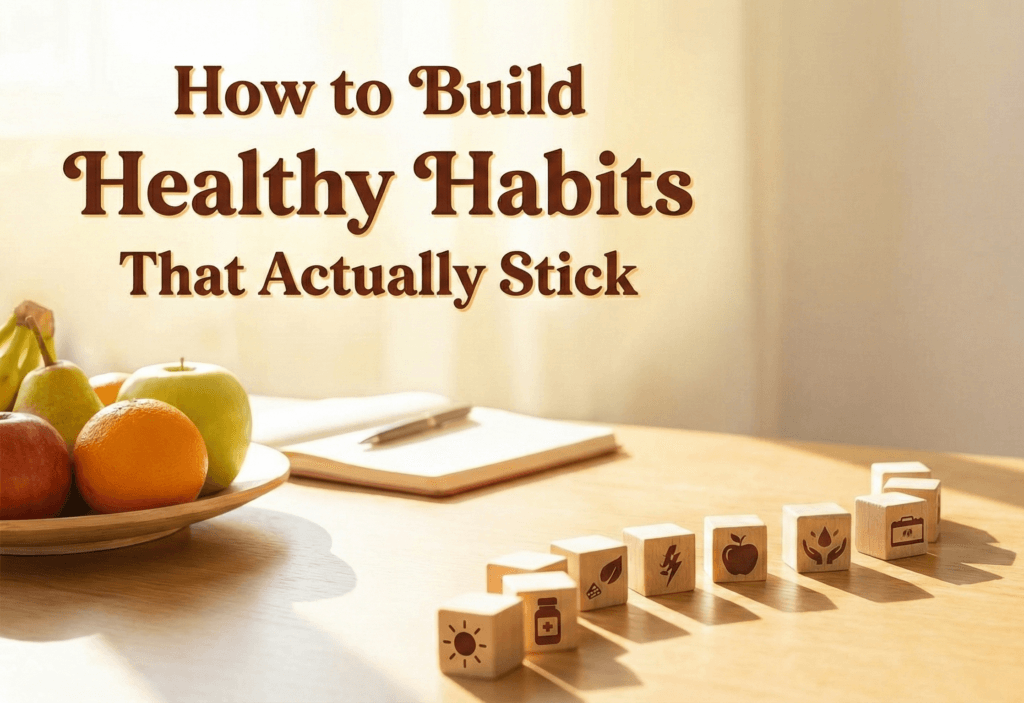
Modern life makes it easy to fall into routines that don’t support our health. Smartphones encourage endless scrolling, unhealthy processed foods are everywhere, and our busy schedules often crowd out sleep, exercise and reflection. Yet research is clear: daily habits not one off intervention are the strongest determinants of long term health. Healthy habits reduce the risk of chronic disease and improve energy, mood and longevity. The challenge is making them stick long enough to become automatic.
This guide explains the science of habit formation and offers step by step strategies for building lasting, health promoting routines. It draws on findings from psychology, neuroscience and public‑health research published up to 2025 and includes evidence backed tips for diet, exercise, sleep and stress management.
Why habits matter: health benefits and myth busting timelines
1. Healthy habits reduce chronic disease risk
Lifestyle factors drive about 80 % of chronic diseases. Physical activity offers immediate and long term benefits. According to the U.S. Centers for Disease Control and Prevention (CDC), even brief sessions of moderate‑intensity exercise can improve brain function and reduce short term anxiety. Regular activity lowers the risk of cardiovascular disease, type 2 diabetes and some cancers. The CDC recommends at least 150 minutes of moderate activity per week, but any amount of movement yields benefits.
Diet matters, too. The Cleveland Clinic notes that whole, minimally processed plant foods help prevent diabetes, heart disease and cancer. The Mediterranean diet rich in fruits, vegetables, whole grains, fish, olive oil and nuts can lower the risk of cardiovascular disease and other chronic conditions. Sleep, stress management and social connection are additional pillars; researchers recommend seven to nine hours of restful sleep per night and the practice of mindfulness to reduce chronic stress.
2. How long does it take to build a habit?
Contrary to popular belief, there’s no magic 21 day rule. A 2024 systematic review led by the University of South Australia analyzed over 2,600 participants and found that new habits begin forming after roughly two months (median 59 to 66 days) but can take up to 335 days to fully establish. In their analysis, habit formation starts within about two months, but times vary from four days to nearly a year.
A study modeling habit formation in daily life showed that automaticity plateaued after an average of 66 days. Larger, more complex behaviors (e.g., doing 50 sit‑ups) took longer than simple actions (e.g., drinking water). Researchers therefore advise people to expect habit formation to take around 10 weeks, noting that missing an occasional repetition does not significantly impair the process.
Machine learning analyses of more than 12 million gym visits and 40 million instances of hand washing found that forming a gym habit typically takes months, whereas hospital staff can develop a hand washing habit in weeks. The key is persistence; giving up because a habit hasn’t stuck after a few weeks cuts the process short. Remember, successful habit formation requires consistency and patience.
The science of habits: how they form and why they stick
1. The habit loop: cue, craving, response, reward
At the heart of every habit is a neurological feedback loop. MIT researchers studying the basal ganglia showed that habits free up cognitive resources but can be difficult to break because they become automatic. Later work expanded the model into the “habit loop,” which consists of four stages:
- Cue: A trigger that starts the behavior (e.g., an alarm clock, walking into the kitchen).
- Craving: The motivation to achieve a desired state (e.g., feeling energized after coffee).
- Response: The action taken to satisfy the craving (e.g., brewing coffee).
- Reward: The outcome that satisfies the craving and reinforces the loop (e.g., increased alertness).
Repeating the loop strengthens neural pathways through neuroplasticity, making the behavior more automatic. The loop works for both healthy and unhealthy habits: stress can trigger scrolling on social media, but the same loop can be redirected to a 10‑minute walk or breathing exercise.
2. Triggers and the three Rs
Harvard health experts refer to the habit cycle as reminder, routine, reward, and emphasize identifying triggers to change behaviour. Research categorizes habit triggers into five groups: location, time, emotional state, other people and the action that immediately precedes the behaviour. Mapping these cues over several days helps reveal patterns (e.g., snacking occurs only when alone at night), enabling targeted interventions.
3. Automaticity develops through repetition in a stable context
Psychologists Benjamin Gardner and Phillippa Lally describe habit formation as a three stage process:
- Initiation phase: select a simple behaviour and a context in which to perform it.
- Learning phase: repeat the behavior consistently in the chosen context; automaticity grows over weeks. Self‑monitoring (e.g., a tick‑sheet) helps sustain motivation.
- Stability phase: the behavior becomes automatic and persists with minimal effort.
Habits form faster when behaviors are simple and performed in the same context. Conversely, varying behaviors and settings, though more interesting, slows automaticity and depends heavily on sustained motivation.
4. Rewards, identity and stress
Habits are reinforced by rewards. An academic review from Trinity College Dublin notes that people who perceived drinking water as rewarding were more likely to develop a habit. External rewards (e.g., treating yourself after a workout) can also reinforce healthy habits.
Stress, however, shifts the brain toward habitual responses and away from goal‑directed behaviour. During chronic stress, fMRI studies show increased reliance on the brain’s habit circuits and reduced activity in the prefrontal cortex. Recognising stress triggers and planning alternative responses is crucial.
5. Implementation intentions and habit stacking
Planning techniques can accelerate habit formation. Implementation intentions (or “if‑then” plans) link a specific situation to a behavior (e.g., “If I feel anxious, then I’ll take five deep breaths”). Research shows that reinforcing implementation intentions with mental imagery increases physical activity habit strength; participants who combined imagery with specific plans saw habit strength increase within three weeks and maintained gains at 12 week follow-up. Implementation intentions create strong situation response associations that mirror habit loops.
Habit stacking involves pairing a new behavior with an existing habit so the established cue triggers the new action. For example, flossing immediately after brushing increased adherence in research participants. Stacking meditation after morning coffee or taking medication while flossing takes advantage of automatic routines to anchor new behaviors. This technique is powerful because it piggybacks on cues already ingrained in daily life.
Evidence based steps for building healthy habits
Below is a comprehensive framework grounded in scientific research. Use these steps to cultivate lasting routines in any domain diet, exercise, sleep or stress management.
1. Choose a simple, specific behavior and set realistic goals
Begin by selecting a single, simple action that aligns with your values and health goals. Complex changes (e.g., training for a marathon) are more prone to failure. Studies show habits form faster when the action is straightforward, like eating a piece of fruit after lunch. Clearly define what, when and where you will perform the behavior; vague intentions (“exercise more”) invite ambiguity.
Motivation and confidence are prerequisites. Harvard’s coaching research suggests rating your motivation and confidence on a scale of 1–10; proceed only if both scores are at least six.
2. Plan the context: time and place
Habits hinge on stable cues. Decide exactly when and where the behavior will occur: “After I finish breakfast at home, I will walk for 10 minutes,” or “When I leave the office at 5 p.m., I will head directly to the gym.” Linking actions to existing routines increases the likelihood that you’ll remember to act. Habit formation requires encountering the cue regularly; choose a time and place encountered every day.
3. Modify your environment to make healthy choices easy
Willpower alone isn’t enough. Adjust your surroundings to remove temptations and lower barriers. The NIH’s wellness toolkit recommends making healthier choices easy by rearranging your environment for example, keep fruit on the counter, remove junk food from your desk and create safe places to walk.
Putting workout clothes next to your bed, preparing a healthy lunch the night before and limiting screen time (e.g., leaving phones outside the bedroom) are environmental tweaks that support your new routines.
4. Identify and manage triggers
Spend a few days observing when and why unwanted behaviors occur. Use the five trigger categories location, time, emotional state, people and preceding action to record patterns. Awareness helps you replace old cues with new ones. If stress triggers late night snacking, plan a relaxing alternative like herbal tea, journaling or stretching.
5. Start small and build gradually
Small wins compound into lasting change. Researchers advise aiming for “tiny habits” rather than drastic overhauls because early success builds self‑efficacy. A sedentary person might start by walking around the block twice a day. Once the action becomes automatic, gradually increase duration or intensity. Avoid random variation; repeating the same small behavior in the same context strengthens the neural association.
6. Use rewards strategically
Positive reinforcement cements behavior. Reward yourself with healthy treats (e.g., a relaxing bath, a new book) after completing a milestone. Rewards can be intrinsic (pride, improved mood) or extrinsic (small gifts). People who perceive an activity as rewarding like drinking water for its refreshing feeling develop stronger habits. External rewards should support, not undermine, intrinsic motivation; choose things aligned with your values.
7. Build accountability and social support
Support from friends, family or groups increases adherence. The NIH suggests asking for support from co‑workers, neighbors or groups when trying to form new habits. Share your goals publicly, partner with a friend or join a community with similar aims. Social accountability taps into our desire not to disappoint others and provides encouragement when motivation wanes.
8. Track progress and celebrate milestones
Monitoring progress keeps you focused and highlights patterns. Keep a habit tracker, checklist or journal; crossing off each successful repetition provides satisfaction and visual feedback. The NIH recommends recording how things are going to catch slip‑ups and stay engaged. Celebrate small milestones (e.g., one week of consistent walks) to reinforce your efforts.
9. Practice habit stacking and implementation intentions
Habit stacking attach your new behavior to an existing routine. Examples include:
- Morning routine: After pouring coffee, meditate for five minutes.
- Oral care: After brushing teeth, floss immediately.
- Medication adherence: Take medication right after flossing.
Implementation intentions prepare for obstacles by creating if‑then plans: “If I feel the urge to check my phone while working, then I’ll turn it over and take a sip of water.” Planning for weak moments makes healthier responses automatic. Research shows that combining imagery with implementation intentions can boost habit strength within weeks.
10. Focus on identity and values
Sustainable habits stem from who you want to become, not just what you want to achieve. Ask yourself: “What type of person exercises daily?” or “What would a healthy eater do?” Aligning actions with your desired identity fosters long term commitment. Research indicates that behaviors selected for personal value are easier habit targets than those pursued to satisfy external demands.
11. Prepare for setbacks and stress
Setbacks are part of the process. When you miss a repetition, treat it as data rather than failure and return to your plan. Stress can trigger a reversion to old habits, so incorporate stress management techniques like mindfulness, meditation and gratitude. Cleveland Clinic experts suggest practicing mindfulness daily observing your breath or body sensations for five minutes and gradually working up to 20 minutes. If you slip, resume the behavior at the next opportunity; missing one occasion does not derail habit formation.
Applying the framework: building healthy habits across domains
1. Nutrition
- Start with one addition. Instead of overhauling your diet, add one serving of vegetables to lunch or swap one processed snack for a piece of fruit. Repeating this after a consistent cue (e.g., when plating lunch) helps it become automatic.
- Adopt the Mediterranean pattern. Emphasize whole grains, vegetables, fruits, legumes, fish, olive oil and nuts; this pattern reduces the risk of cardiovascular disease and other chronic diseases.
- Plan your environment. Keep healthy options visible and store sugary snacks out of sight. Batch cook meals or prep vegetables ahead of time to make healthy choices convenient.
- Reward yourself with health‑aligned treats. Try a relaxing herbal tea after cooking a plant based meal.
2. Physical activity
- Follow the 150 minute guideline. Aim for at least 150 minutes of moderate activity per week, such as brisk walking, cycling or dancing. Start with 10 minute walks two or three times a day.
- Identify your cue. Schedule exercise at the same time daily before breakfast or immediately after work. Lay out workout clothes the night before.
- Use habit stacking. Pair strength training with another routine (e.g., do push‑ups after brushing teeth).
- Track and reward. Mark each workout on a calendar and celebrate weekly consistency with a nonfood reward.
3. Sleep
- Set a consistent bedtime. Aim for seven to nine hours of sleep; go to bed and wake at the same time even on weekends.
- Create a wind down ritual. Stack sleep hygiene habits: put away digital devices 90 minutes before bed, dim lights, stretch, write a gratitude list and read a relaxing book.
- Optimize the environment. Keep your bedroom cool, dark and quiet. Remove electronic devices or use blue light filters to minimize stimulation.
4. Stress management
- Practice mindfulness. Schedule five minutes of mindful breathing daily and gradually increase to 20 minutes. Observe sensations without judgment; use triggers like making coffee or sitting at a stoplight as cues.
- Adopt gratitude and journaling. Write down three things you are grateful for each day. This can reduce stress and shift focus to positive experiences.
- Use if‑then plans. When feeling overwhelmed, replace the urge to scroll social media with a short walk or call a friend.
Conclusion
Building healthy habits that stick is a marathon, not a sprint. Scientific evidence dispels the 21 day myth; most habits require months of consistent repetition to become automatic. The process involves understanding cues and triggers, choosing simple behaviors, repeating them in stable contexts, rewarding progress and adjusting the environment to make healthy choices easy. Techniques such as habit stacking and implementation intentions can accelerate automaticity, while mindfulness and stress management prevent relapse during challenging periods.
Remember that self-compassion and patience are essential. Improvement takes time and setbacks happen. Focus on incremental progress rather than perfection. By applying these science backed strategies, you can build a foundation of healthy habits that support wellbeing for years to come.
Frequently Asked Questions
What exactly is a “healthy habit”?
A healthy habit is a repeated behavior that supports your physical, mental, or emotional wellbeing. Examples include regular movement, eating mostly whole foods, sleeping 7 to 9 hours, managing stress, and limiting screen time at night. Over time, these actions become automatic, so they require less effort and willpower.
Why do my habits never seem to stick?
Most habits fail because they are too big, too vague, or depend entirely on motivation. People often try to overhaul their entire life at once, instead of focusing on one small, repeatable action in a specific context. Sustainable change comes from simplifying the habit, tying it to a clear cue, and repeating it consistently rather than relying on willpower alone.
How long does it really take to form a new habit?
There is no universal “21 day rule.” Research shows that habit formation can take anywhere from a few weeks to several months, depending on the person and the behavior. Simple habits (like drinking a glass of water after breakfast) tend to form faster than complex ones (like going to the gym five times a week). The key is: consistency over time matters more than chasing a specific number of days.
How small should my first habit be?
Smaller than you think. If the habit feels so easy it’s almost a joke, you’re in the right range. Your first job is not to “get results fast”; it’s to become the kind of person who shows up every day. Once the behavior is automatic, you can gradually increase the duration, intensity, or frequency.
What is “habit stacking” and how do I use it?
Habit stacking means attaching a new habit to one you already do automatically. The formula is:
“After I [current habit], I will [new tiny habit].”
For example: “After I brush my teeth, I will floss one tooth” or “After I make my morning tea, I will write my top 3 priorities for the day.” The existing habit acts as a reliable cue for the new one.
How many habits should I work on at once?
For most people, one core habit (or at most two) is ideal to start. The more habits you add at the same time, the more you dilute your attention, energy, and willpower. Build one habit until it feels fairly automatic, and then add another. Think “sequence,” not “overhaul.”
How important is my environment for building healthy habits?
Your environment is often more powerful than your willpower. If you surround yourself with constant triggers for unhealthy behaviors (junk food everywhere, phone by the bed, no defined workspace), you are creating a daily uphill battle. For habits that stick, redesign your environment so the “right” choice is the easiest and most obvious one.
Can I build healthy habits if my schedule is very busy?
Yes, but you must design micro-habits that fit into your real life, not your ideal life. Think in terms of 1 to 10 minute actions: a 5 minute walk, 2 minutes of stretching, writing a quick reflection before bed. Attach these tiny behaviors to existing routines (after meetings, after meals, before opening email) so they piggyback on what you already do.
What if I feel stressed, low, or burned out can I still build habits?
During high stress or low energy periods, aim for maintenance, not perfection. Shrink habits to the bare minimum (for example, “one stretch”, “one paragraph”, “one glass of water”). Prioritize sleep, movement, and simple meals. If your mood is persistently low or your functioning is impaired, consider speaking to a qualified health professional habits are powerful, but they are not a replacement for proper medical or psychological care.
Are “healthy habits that stick” really possible for everyone?
Perfection is not realistic, but meaningful improvement is. Almost everyone can create some stable, supportive habits if they: start small, choose personally meaningful goals, design clear cues, repeat consistently, and make their environment work for them. The question is rarely “Can I change?” it is “Am I willing to design my life so change becomes easier than staying the same?”
Do apps and habit trackers really help?
They can. Habit trackers (apps or simple paper charts) make your progress visible, which supports motivation and consistency. The key is to:
- Track only a few high-impact habits.
- Update your tracker at the same time each day.
- Use it as feedback, not as a source of guilt.
Pick whatever system you’re actually willing to use daily.