We have all been there. You have a deadline looming, a project that needs your attention, or a simple chore you promised to finish. Yet, instead of tackling it, you find yourself deep in a social media scroll, reorganizing your desk, or suddenly deciding it’s the perfect time to clean the entire kitchen.
This is procrastination. It is not just about being lazy; it is a complex psychological battle between your intentions and your actions. While everyone procrastinates occasionally, chronic procrastination can lead to stress, missed opportunities, and a persistent feeling of guilt.
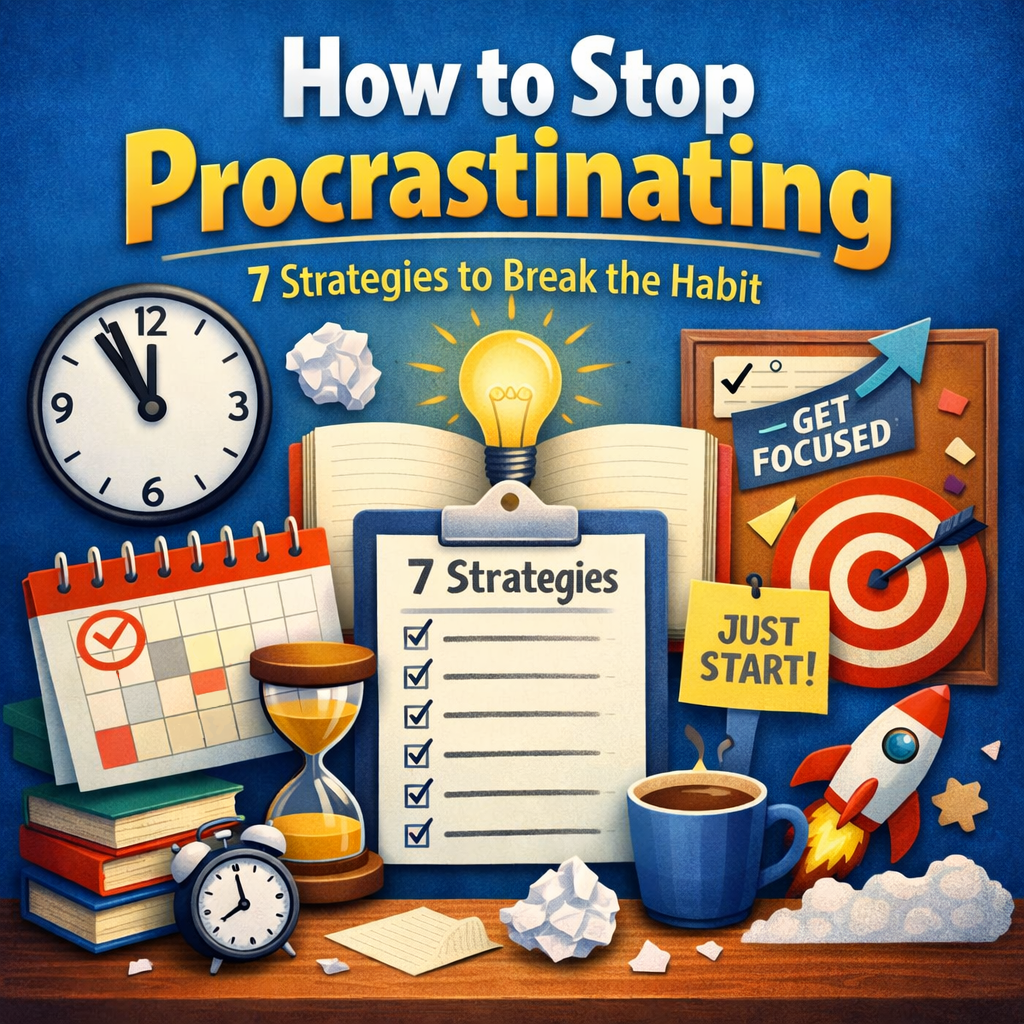
The good news? Procrastination is a habit, and like any habit, it can be broken. This guide will explore the root causes of why we delay tasks and provide 7 proven, actionable strategies to help you reclaim your time and productivity.
Understanding “Why”: The Psychology of Procrastination
Before diving into the solutions, it is crucial to understand the problem. Psychologists often define procrastination as a form of “time inconsistency.” This is the conflict between your Present Self and your Future Self.
Your Future Self sets goals (e.g., “I will finish this report by Friday”). However, your Present Self is the one who has to actually do the work. The Present Self prefers instant gratification, watching a video, eating a snack, or napping over the long term reward of finishing the task. Procrastination is often driven by negative emotions associated with the task at hand, such as:
- Fear of Failure: Worrying that the result won’t be good enough.
- Perfectionism: Waiting for the “perfect” time or conditions to start.
- Overwhelm: Feeling paralyzed by the sheer size or complexity of a project.
- Lack of Motivation: Viewing the task as boring or unpleasant.
By recognizing these triggers, you can choose the right strategy to overcome them. Here are seven powerful ways to stop procrastinating today.
1. The Two Minute Rule
One of the biggest hurdles to productivity is simply getting started. Newton’s First Law of Motion applies to human behavior too: objects at rest tend to stay at rest. The Two Minute Rule, popularized by productivity expert David Allen, is designed to overcome this inertia.
The concept is simple: if a task takes less than two minutes to complete, do it immediately. This applies to small things like replying to an email, washing a dish, or filing a document.
For larger tasks that definitely take longer than two minutes, you can tweak the rule. Tell yourself you will just work on the task for two minutes. Anyone can focus for 120 seconds. Once you start, the friction of beginning disappears, and you will likely find it easier to keep going. The hardest part is almost always the start; once you break that seal, momentum takes over.
2. Break It Down: The “Salami Slice” Method
Large projects are intimidating. When you look at a task like “Write a Book” or “Launch a Website,” your brain registers it as a massive, painful undertaking. This triggers a fight or flight response, leading to avoidance.
The solution is to “slice” the task into tiny, manageable pieces, much like slicing a salami. Instead of writing “Finish Project Report” on your to-do list, break it down into actionable steps:
- Open a blank document.
- Write the title.
- Draft the introduction.
- Gather data for section one.
By focusing on these micro tasks, you trick your brain. Checking off “Open document” feels easy and rewarding. This creates a dopamine hit a chemical reward in your brain that encourages you to tackle the next slice. This method reduces overwhelm and turns a mountain into a series of small, climbable hills.
3. Utilize the Pomodoro Technique
Time management is often less about managing time and more about managing energy. The Pomodoro Technique, developed by Francesco Cirillo, is a structured method to maintain focus and prevent burnout. Here is how it works:
- Choose a task you want to work on.
- Set a timer for 25 minutes.
- Work on the task with intense focus until the timer rings. Do not check your phone or switch tabs.
- Take a short 5 minute break. Stretch, grab water, or walk around.
- Repeat the cycle. After four “Pomodoros,” take a longer break of 15 to 30 minutes.
This technique works because it creates a sense of urgency. Knowing you only have 25 minutes pushes you to be efficient. Furthermore, the promise of a guaranteed break makes the work feel less endless. It creates a rhythm of work and rest that keeps your mind fresh and reduces the dread of “hours of work” stretching ahead of you.
4. Manage Your Environment (Digital and Physical)
Willpower is a finite resource. If you constantly have to fight the urge to check your phone or look at the TV, you will eventually lose. Instead of relying on willpower, design an environment that makes procrastination difficult.
Physical Environment
If your workspace is cluttered, your mind will likely feel cluttered. Spend five minutes clearing your desk before you start. Remove distractions like game consoles, piles of laundry, or unrelated paperwork from your line of sight.
Digital Environment
Digital distractions are the modern procrastinator’s biggest enemy. To combat this:
- Turn off notifications: Put your phone on “Do Not Disturb” or leave it in another room.
- Use website blockers: Tools like Freedom or Cold Turkey can block access to social media sites during work hours.
- Clean up your browser: Close unnecessary tabs. If you have 20 tabs open, you are inviting your brain to wander.
By adding friction to your bad habits (e.g., hiding the remote, logging out of Instagram) and removing friction from good habits (e.g., having your notebook open and ready), you automate discipline.
5. Visualizing the Process, Not Just the Outcome
We are often told to “visualize success.” While imagining yourself holding a trophy or receiving a promotion feels good, it can actually backfire. It gives your brain a premature sense of accomplishment, which can sap your motivation to do the actual work.
Instead, practice process visualization. Imagine yourself performing the steps required to achieve the goal. Visualize yourself sitting down at your desk, ignoring your phone, typing the words, or making the difficult phone call.
Focusing on the process prepares your brain for the reality of the work. It helps you anticipate obstacles (like getting bored or distracted) and mentally practice overcoming them. This shifts your mindset from “dreaming” to “doing.”
6. Practicing Self-Compassion
This might sound counterintuitive. Many of us believe we need to be hard on ourselves to get things done. We think, “I’m so lazy, I need to discipline myself.” However, studies show that self-criticism often leads to more procrastination.
When you beat yourself up for procrastinating, you increase your stress and negative feelings associated with the task. To avoid those negative feelings, you procrastinate again, creating a vicious cycle known as the “procrastination doom loop.”
Try self-compassion instead. Acknowledge that you procrastinated, forgive yourself, and move on. Tell yourself, “Okay, I wasted the last hour. That happens. I will restart now.” By reducing the guilt, you remove the emotional weight that prevents you from trying again. It is easier to start fresh when you aren’t carrying the baggage of past failures.
7. Find an Accountability Partner
Procrastination thrives in isolation. When you are the only one who knows you haven’t done your work, it is easy to make excuses. Bringing another person into the equation changes the dynamic entirely.
Find a friend, colleague, or mentor to be your accountability partner. You don’t need them to do the work for you; you just need them to check in. You can set up a system like this:
- Morning Check-in: Text your partner your top 3 goals for the day.
- Evening Check-in: Report back on whether you completed them.
The social pressure of not wanting to let someone else down (or admit you did nothing) is a powerful motivator. For deeper accountability, you can even use “body doubling,” where you work alongside someone else (virtually or in person) in silence. Just the presence of another working person can help keep you focused.
Conclusion
Overcoming procrastination is not a one-time event; it is a practice. You will not become a productivity machine overnight. There will still be days when you struggle to get off the couch, and that is okay. The goal is progress, not perfection.
Start by picking just one of the strategies above. Maybe tomorrow you try the Two Minute Rule, or you download a website blocker. Experiment with what works for your specific personality and workflow.
Remember, the pain of procrastination is almost always worse than the pain of doing the work. The relief and pride you feel after finishing a task are worth the initial struggle of starting.
Frequently Asked Questions
Why do I procrastinate?
It’s rarely about laziness. It is usually emotional regulation. Your brain avoids a task because it associates it with negative feelings like boredom, fear of failure, or overwhelming stress. You aren’t avoiding the work; you’re avoiding the bad mood the work causes.
Is all procrastination bad?
Not necessarily. Active procrastination (deliberately waiting until the last minute because you thrive under pressure) can be effective for some. However, passive procrastination (stalling because you are paralyzed) is what leads to burnout and poor results.
How does “perfectionism” cause delay?
If you believe a task must be done perfectly, the pressure becomes so high that your brain views the task as a threat. Procrastination becomes a defense mechanism: if you don’t start, you can’t “fail.”
Can a messy desk make it worse?
Yes. Visual clutter competes for your attention. A chaotic environment signals to your brain that there is “unfinished business” everywhere, which increases mental fatigue and makes it harder to focus on a single objective.
What should I do if I feel overwhelmed?
Lower the bar. Instead of trying to “write a report,” commit to “typing one sentence.” Shrink the task until it feels so easy that it’s impossible to say no to.