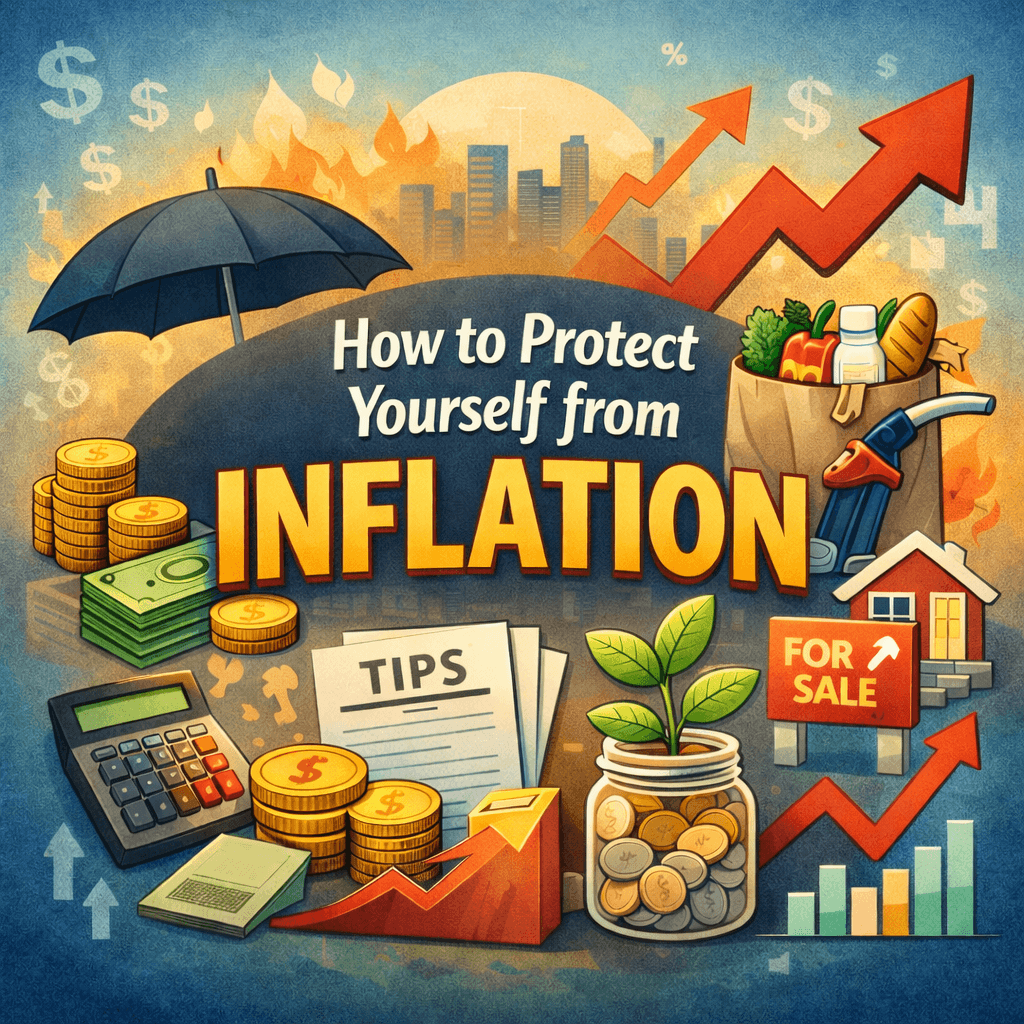
Inflation is one of those economic forces that quietly erodes the value of money. A loaf of bread that cost $1 a few years ago might be $3 today. When overall prices rise faster than incomes, purchasing power shrinks and savings lose value. The inflation spike witnessed in many countries after the pandemic reminded savers and investors alike that the cost of living doesn’t always remain stable. The U.S. and Europe, for example, saw inflation surge beyond 9 % in 2022 before retreating. That experience has pushed people everywhere to seek ways to shield their wallets from rising prices.
Protecting yourself from inflation does not mean outrunning every price increase, but it means building a financial plan that keeps your spending power intact over time. This article explains what inflation is, why it matters, and the strategies you can use to maintain or even grow your wealth when prices are climbing. The guidance is general in nature; you should always consult professionals regarding your specific financial circumstances.
Understanding Inflation and Its Effects
Inflation refers to a general increase in the price level of goods and services over time. When inflation occurs, the currency you hold today buys less in the future. The United Nations Federal Credit Union notes that during inflationary periods the cost of everything from commodities such as food and housing to services like health care can rise, while purchasing power and the value of each currency unit decreases. That is why an item costing $1 in the 1920s might cost roughly $18 today. Even if you do not change your lifestyle, you end up spending more because the currency itself has lost value. This erosion of purchasing power can put a strain on household budgets and cause anxiety about the value of savings.
Inflation is usually measured by indices such as the Consumer Price Index (CPI), which track the average prices of a basket of goods and services. In most economies central banks aim for a modest inflation rate around 2 % in the United States to encourage spending and investment without eroding savings too quickly. High inflation becomes problematic when prices outpace wage growth or interest rates on savings. Rising prices are often triggered by supply disruptions (such as during a pandemic), strong consumer demand, expansive fiscal policies or higher commodity costs. Central banks respond by tightening monetary policy, typically raising interest rates, which slows borrowing and spending.
Why Protecting Against Inflation Matters
Inflation reduces the real value of money left sitting idle. If inflation averages 5 % per year and your savings account pays 1 %, your purchasing power falls by roughly 4 % annually. Many people discovered this in 2022 to 2025 when inflation was well above 4 % in the U.S. Without a plan, inflation can erode decades of hard‑earned savings. Protecting against inflation matters because:
- The cost of essentials rises: Food, energy, rent and medical care tend to increase quickly during inflationary periods, leaving less money for discretionary spending. Quiver Financial notes that food and energy categories are often hit hardest, with grocery prices rising 20 to 25 % between 2021 and 2023.
- Savings lose value: When money earns less than inflation, it effectively shrinks in value. Keeping cash in low‑yield accounts means losing purchasing power every month.
- Debt becomes more expensive: Central banks raise interest rates to combat inflation, and those increases quickly affect variable‑rate loans and credit card balances. UNFCU warns that credit card debt becomes more expensive when rates rise, so paying it off saves money.
- Investment returns can be volatile: Inflation can cause market volatility as investors react to interest‑rate hikes and changes in corporate profitability. A solid strategy is necessary to avoid panic selling and to stay invested for the long term.
Build a Solid Emergency Fund in High‑Yield Accounts
One of the first defenses against inflation is keeping your emergency savings in an account that earns a competitive interest rate. UNFCU advises placing money set aside for the future in a savings account that pays dividends or interest so that your balance gradually increases over time. High‑yield savings accounts from reputable online banks often pay much higher annual percentage yields (APYs) than traditional brick‑and‑mortar banks. According to Quiver Financial, high‑yield savings accounts offered APYs between about 4.5 % and 5.2 % in late 2025, far outperforming traditional savings accounts, and these rates rise when central banks raise rates. Money market accounts are another option for emergency funds; they provide slightly higher rates and allow limited check‑writing. Certificates of Deposit (CDs) can lock in attractive rates, but they are best when you expect interest rates to fall in the future. When building your emergency fund:
- Aim for three to six months of essential expenses. The size of your emergency fund depends on job stability, income variability and household needs. During inflationary periods it may be wise to hold at least six months of expenses because job markets can tighten.
- Keep the fund liquid. Use high‑yield savings or money market accounts that allow easy access without penalty. CDs might be used for part of your fund if you stagger maturity dates, but avoid tying up all of your emergency money for long periods.
- Compare APYs to inflation. If inflation runs at 4 % and your savings account earns 1 %, you are losing 3 % of purchasing power annually. Switching to higher‑yield options can recover much of that loss.
Track Your Spending and Adjust Your Budget
Managing your budget effectively is crucial when prices rise. UNFCU recommends tracking your spending and identifying expenses that can be trimmed. Review recent bank and credit‑card statements to see where your money goes. Are you paying for streaming services you don’t use or eating out more than you thought? Small adjustments such as cancelling an unused subscription or cooking at home more often can reduce financial strain without significantly impacting your lifestyle.
Quiver Financial suggests adopting a flexible budgeting rule, such as the 50/30/20 framework (needs/wants/savings), and temporarily shifting to a 55/25/20 split during high‑inflation periods to account for higher essential costs. Budgeting apps like Mint or YNAB (You Need A Budget) automatically categorize spending and help identify inflation “pain points.” Reassess your budget monthly because prices can change quickly. Meal planning and bulk buying of non‑perishables, as well as using store loyalty programs and cash‑back apps, can reduce grocery bills by 8 to 12 %. These everyday savings can be redirected toward debt payments or investments.
Tackle High‑Interest and Variable‑Rate Debt
Another critical step is managing your debt. As central banks raise interest rates to fight inflation, variable‑rate loans, credit cards, home equity lines of credit (HELOCs), some student loans and adjustable‑rate mortgages become more expensive. UNFCU notes that variable‑rate debt sees minimum payments jump, sometimes covering only interest, while fixed‑rate mortgages remain unchanged. Therefore, focus on paying down credit card balances and other high‑interest or variable‑rate loans first. Even small additional payments can save significant interest over time.
For mortgages, fixed‑rate loans provide stability because your payment stays constant while incomes may rise with inflation. Quiver Financial observes that a fixed‑rate mortgage becomes more affordable over time if your salary increases, whereas adjustable‑rate mortgages (ARMs) may see rates rise as central banks hike rates. ARM loans might make sense if you plan to sell the property before the rate reset or if the initial rate is significantly lower than the fixed rate, but be prepared for potential payment increases. Avoid refinancing a low fixed rate into a higher one simply to access home equity; consider a HELOC instead. If you hold multiple debts, create a debt elimination strategy:
- List debts by interest rate and type. Pay extra toward the highest‑rate, variable‑rate debts first while making minimum payments on fixed‑rate or low‑rate loans.
- Consider consolidation. Personal loans with fixed rates can consolidate high‑interest credit cards. Quiver notes that many borrowers save money through strategic debt consolidation and lower monthly payments.
- Avoid new debt for non‑essential purchases. Inflation can tempt consumers to buy now before prices rise further, but unnecessary borrowing can lead to costly interest charges.
Invest in Inflation‑Protected Securities
Investing is essential to preserving wealth, but you need assets that can keep pace with or exceed inflation. Treasury Inflation‑Protected Securities (TIPS) and Series I savings bonds are two government‑backed options specifically designed to protect against inflation.
1. Treasury Inflation‑Protected Securities (TIPS)
TIPS are U.S. Treasury bonds whose principal value adjusts with inflation. When inflation rises, the principal value of a TIPS increases, and when deflation occurs, the principal decreases. Charles Schwab notes that the coupon payments of a TIPS are calculated on the adjusted principal, so investors benefit from higher income payments during periods of rising inflation. At maturity, the investor receives either the adjusted principal or the original principal whichever is greater ensuring that TIPS do not repay less than their initial value. This makes TIPS a reliable long‑term hedge rather than a short‑term inflation “bandage.” Schwab points out three main considerations when evaluating TIPS:
- Positive “real” yields. TIPS yields are quoted as real yields returns after accounting for inflation. In late 2025, real yields were near the high end of their 15‑year range, meaning investors could earn a positive inflation‑adjusted return regardless of the inflation rate.
- Breakeven rates. The breakeven inflation rate is the difference between TIPS yields and traditional Treasury yields. Inflation must average above this breakeven rate over the life of the bond for TIPS to outperform conventional Treasuries. In September 2025 the five‑year breakeven rate was about 2.5 %, below headline inflation at the time.
- Investment horizon. Because principal adjustments occur over the life of the bond, TIPS are more effective as a long‑term hedge. Short‑term holders may see volatile price movements as real yields fluctuate with interest‑rate policy.
When incorporating TIPS into your portfolio, consider laddering different maturities (5 year, 10 year, 30 year) or using a TIPS mutual fund or exchange‑traded fund (ETF) for diversification. Remember that TIPS can be more expensive than conventional Treasuries and may underperform if inflation stays low.
2. Series I Savings Bonds (I Bonds)
Series I savings bonds (I bonds) are another way to guard your cash against inflation. NerdWallet explains that I bonds combine a fixed interest rate with a variable inflation rate that adjusts twice a year based on changes in the CPI. When inflation increases, the composite rate for I bonds rises; when inflation falls, it declines. For the period ending April 30 2026 the composite rate was 4.03 %. Unlike TIPS, I bonds can be purchased electronically or, in limited amounts, in paper form. The minimum purchase is US$25 and the maximum is US$10 000 (electronic) or US$5 000 (paper) per calendar year. You must hold an I bond for at least 12 months, and cashing in before five years results in forfeiture of the most recent three months’ interest.
I bonds carry additional benefits: they are backed by the U.S. government, and interest is exempt from state and local taxes. Interest can also be tax‑free when used for qualified education expenses. Because of purchase limits and redemption restrictions, I bonds are best suited for medium‑term savings (one to five years). Use them as part of an emergency or opportunity fund rather than a comprehensive investment portfolio.
3. Inflation‑Friendly Investment Mix
While TIPS and I bonds provide explicit inflation protection, other assets have historically outpaced inflation over long periods:
- Equities represent ownership in companies that can raise prices to maintain profit margins during inflation. Quiver Financial notes that historical stock returns average 8 to 10 % annually, typically exceeding inflation. Stay diversified across sectors and avoid panic selling when markets react to rate hikes.
- Real estate. Property values and rents often rise with inflation because replacement costs (materials and labor) increase. A 2025 article from Shubhashish Homes highlights that Indian real estate historically grows 9 to 11 % annually and often outpaces inflation. Real estate provides a tangible asset and rental income that adjusts upward with living costs. Furthermore, long‑term mortgages effectively let borrowers repay with cheaper future euro or dollars.
- Real estate investment trusts (REITs). If direct property ownership is not feasible, REITs offer exposure to real estate appreciation and rental income with lower upfront capital.
- Commodities and gold. Commodities like oil, agricultural goods and precious metals tend to rise with inflation, though they are volatile. Gold has long been a store of value but produces no income; it may underperform once inflation stabilizes.
- Diversified portfolios. Combining assets can smooth returns. Quiver suggests one possible allocation: 60 % stocks for growth, 20 % TIPS or I bonds for inflation protection, 15 % high‑yield savings for liquidity and 5 % REITs for real estate exposure. This is just an example; actual allocations should reflect your risk tolerance, time horizon and financial goals.
Invest in Yourself and Increase Income
While managing savings and investments is crucial, increasing your earning potential is equally important. Inflation hits hardest when income growth lags behind rising prices. Investing in your skills through education, training or certifications can lead to better job opportunities and higher earnings. Consider side hustles or freelancing to diversify income streams. For business owners, inflation can reduce margins; raise prices carefully, negotiate supplier contracts, and look for ways to improve productivity.
Building career resilience also means staying adaptable in a changing economy. Fields such as technology, healthcare and renewable energy may offer growth opportunities. Negotiating salary increases or seeking promotions helps maintain your income’s purchasing power. Although personal development strategies don’t have direct citations here, many financial advisers highlight the importance of human capital as an inflation hedge.
Adopt Smart Spending Habits
Protecting yourself from inflation isn’t solely about investing it also involves thoughtful consumption. Here are strategies to stretch your euro or dollars further:
- Meal planning and bulk buying. Planning meals reduces food waste and impulse purchases. Quiver reports that meal planning can cut grocery bills by 15 to 25 %, while buying non‑perishables in bulk can provide additional savings. Bulk purchases should be limited to items you use regularly to avoid waste.
- Use loyalty and rewards programs. Store loyalty programs, cash‑back apps and reward credit cards can provide discounts or points that offset higher prices. UNFCU suggests choosing a rewards credit card and paying off the balance each month to avoid interest. Redeeming points for cash, travel or gift cards increases the value of your spending.
- Negotiate bills and subscriptions. Inflation can lead to “subscription creep.” Contact service providers to negotiate better rates for internet, mobile service or insurance. Cancel or downgrade services you seldom use.
- Reduce energy costs. Invest in energy‑efficient appliances, weather‑proof your home and reduce electricity consumption to cushion rising utility costs.
Prioritize Tax Efficiency
High inflation often coincides with changes in fiscal policy and tax brackets. To retain more of your income:
- Maximize tax‑advantaged accounts. Contributing to retirement accounts like 401(k)s, IRAs voluntary pension schemes can lower taxable income and allow investments to grow tax‑deferred.
- Utilize tax‑free savings instruments. I bond interest is exempt from state and local taxes and can be tax‑free when used for education. In some countries, government‑backed savings certificates or Sukuk bonds may offer tax benefits.
- Offset capital gains with losses. If you sell investments at a profit, consider selling underperforming assets to harvest losses and reduce your taxable capital gains.
- Consult a tax professional. Tax rules vary by country and can change frequently. Guidance from a qualified professional ensures you optimize deductions and credits.
Build Long‑Term Financial Resilience
Inflation is one of many risks facing your finances. Building resilience means preparing for multiple scenarios:
- Diversify globally. Inflation and economic cycles differ across countries. Investing in international equities and bonds spreads risk and captures growth in other regions.
- Maintain insurance coverage. Adequate health, life and property insurance protect your assets and income from unexpected expenses.
- Plan for retirement. Inflation can dramatically affect retirement expenses. Use realistic inflation assumptions (3 to 4 % in many planning models) when estimating future needs. Increase retirement contributions when you receive raises to keep pace with rising costs.
- Stay informed. Economic conditions evolve quickly. Monitor inflation reports, central‑bank policies and market trends. Regularly reassess your strategy and make adjustments as needed.
- Seek professional advice. Financial advisers can help tailor strategies to your goals, risk tolerance and tax situation. They may suggest additional inflation‑hedging instruments like commodities funds, infrastructure investments or floating‑rate bonds.
Conclusion
Inflation is an inevitable part of economic life. While you cannot control price levels, you can control how you prepare. By building an emergency fund in high‑yield accounts, tracking spending, paying down high‑interest debt, investing in inflation‑protected securities, diversifying into real assets and equities, and continually improving your earning power, you create a financial system that withstands rising costs. As the UNFCU points out, even small adjustments such as moving savings into interest‑bearing accounts or canceling unused services can lessen inflation’s impact on your budget. Government‑backed TIPS and I bonds provide explicit protection by adjusting with inflation, while investments in stocks and real estate historically outpace inflation over the long term. Managing debt smartly and leveraging tax‑advantaged accounts further shield your wealth.
Ultimately, safeguarding your purchasing power requires a proactive and diversified approach. Inflation may ebb and flow, but with the right strategies you can preserve and grow your wealth ensuring that today’s money continues to meet tomorrow’s needs.
Financial Disclaimer
The information provided on this blog is for educational and informational purposes only and should not be considered financial, investment, tax, or legal advice. All content is general in nature and may not apply to your individual circumstances.
While we strive to keep the information accurate and up to date, we make no warranties or guarantees regarding completeness, reliability, or accuracy. Any actions you take based on the information on this blog are strictly at your own risk.
Before making any financial decisions, you should consult a qualified professional who can consider your specific goals, income, risks, and personal situation.
Frequently Asked Questions
What is inflation, in simple terms?
Inflation is the general rise in prices over time. When inflation increases, each unit of currency buys fewer goods and services, which reduces your purchasing power.
Why is inflation a problem for savings?
If your money sits in cash or a low-interest account while prices rise, the real value of your savings declines. In other words, your balance may look the same, but it can buy less than before.
Should I keep an emergency fund during inflation?
Yes. Inflation increases the cost of surprises (repairs, medical bills, job transitions). A solid emergency fund can prevent you from relying on high-interest debt. The key is balancing liquidity (easy access) with earning some interest.
What are TIPS and how do they help with inflation?
TIPS (Treasury Inflation-Protected Securities) are government bonds whose principal is indexed to inflation, so the principal adjusts up when inflation rises (and down with deflation). This design can help buffer against inflation over time.
Are I Bonds good for inflation protection?
I Bonds are designed to protect savings from inflation. Their rate combines a fixed rate and an inflation component that updates based on CPI-U; the composite rate changes over time. They also have holding rules (e.g., you generally must hold for at least a year) and may have penalties for early redemption.
Can increasing income help protect against inflation?
Yes. Inflation is ultimately a cash-flow problem for many households. Building skills, negotiating pay, adding side income, or shifting toward in-demand work can help your income keep pace with rising costs (often more effectively than trying to “out-invest” inflation with excess risk).
How long does inflation typically last?
It varies widely. Some inflation episodes are short (supply shocks), while others last longer. Your goal should be building a plan that works across scenarios, not trying to time inflation’s peak.