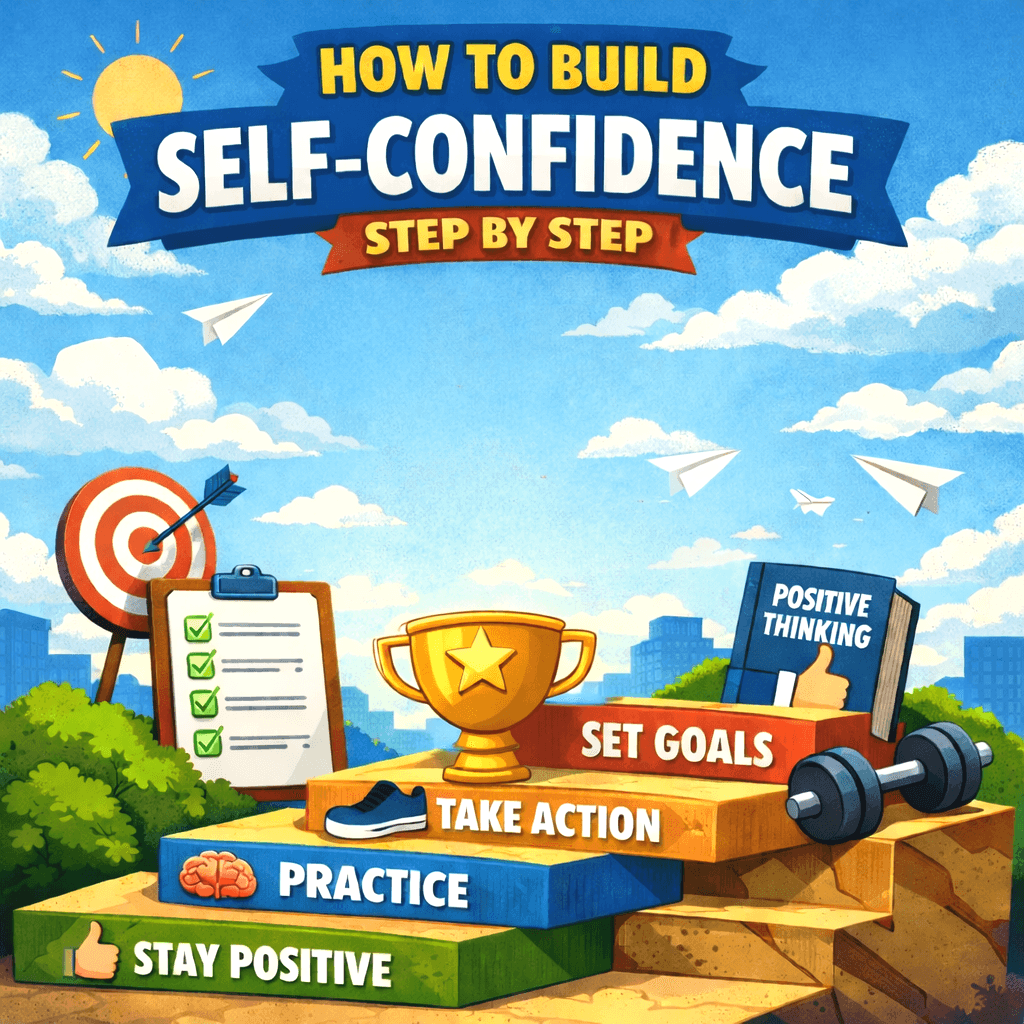
Self‑confidence is the belief that you can handle challenges and succeed. A strong sense of confidence positively affects relationships, career, and mental and physical health. Research reported by Mayo Clinic notes that low self‑esteem can affect nearly every aspect of life relationships, job and health but mental‑health techniques can help you boost confidence. Because self‑confidence influences how we think, feel and act, deliberately strengthening it can improve how you feel about yourself and how others perceive you. This long‑form guide uses evidence‑based psychology and cognitive behavioural therapy (CBT) principles to show you step‑by‑step how to build self‑confidence.
Understanding Self‑Confidence and Self‑Esteem
1. Self‑esteem vs. self‑confidence
Self‑esteem refers to the value we place on ourselves and how we view our worth. The NHS explains that people with healthy self‑esteem tend to feel positive about themselves and life, while those with low self‑esteem see themselves and their life in a more negative and critical light. Self‑confidence is closely related it is our belief in our ability to handle challenges and succeed.
2. Why it matters
A strong sense of confidence helps us to take risks, learn new skills and build healthy relationships. Insecure individuals may avoid challenges or hide away from social situations, reinforcing doubts and fears. Confident people, on the other hand, tend to be open‑minded, willing to take risks, optimistic and able to learn from mistakes.
3. How low confidence develops
Low self‑esteem often begins in childhood. Teachers, family, friends and the media send explicit and implicit messages that shape how we view ourselves. Stressful life events, illness, bullying, discrimination and unrealistic expectations can also erode confidence.
Developing self‑confidence is not a quick fix; it involves changing thought patterns, behaviours and emotional responses. The following steps draw on cognitive behavioural therapy, positive psychology and counselling research to help you gradually build lasting confidence.
Step 1: Recognise Situations That Trigger Low Confidence
Before you can change unhelpful thought patterns, you need to understand what triggers them. The Mayo Clinic suggests reflecting on situations that deflate your self‑esteem, such as a work presentation, a crisis at home, conflicts with loved ones or a major life change. Keep a journal to identify patterns when you feel anxious or negative about yourself, note the situation and the thoughts you had. The NHS inform self‑help guide proposes writing down the situation, your internal thoughts (what you told yourself), any “permanent” assumptions about what it means for the future, and “global” beliefs about what it means for every situation. This exercise helps you see whether you are applying sweeping negative conclusions to one event.
Tools to try
- Journal triggers: Write down situations that make you feel unconfident, your thoughts and physical sensations.
- Body cues: Notice physiological responses such as a racing heart or tense muscles. Positive psychology research highlights that physiological arousal (fatigue, fear or anxiety) can undermine self‑efficacy and confidence.
- Assess thought patterns: Ask whether your thoughts are rational or based on assumptions. Would you say them to a friend? If not, they may be distorted.
Step 2: Become Aware of Your Thoughts and Beliefs
Once you have identified triggering situations, examine your inner dialogue. In CBT this is called self‑talk. The Mayo Clinic notes that thoughts can be positive, negative or neutral and may be based on facts or false ideas. Automatic negative thoughts (ANTs) often appear quickly and feel believable, but they are usually unhelpful or untrue. The NHS guide describes common patterns of unhelpful thinking:
- Black‑and‑white thinking: Seeing things as all good or all bad, with no middle ground.
- Over‑generalising: Assuming that one event means all future events will go the same way.
- Dismissing positives: Ignoring successes and focusing on negatives.
- Emotional reasoning: Treating feelings as facts (e.g., “I feel alone; therefore no one cares about me”).
- “Should” statements: Placing rigid expectations on yourself (e.g., “I should never make mistakes”).
Understanding these patterns helps you spot when your mind is distorting reality.
Tools to try
- Mindfulness meditation: Meditation helps you observe thoughts without reacting, reducing the power of negative self‑talk. A 2015 study cited by Verywell Mind found that meditation improves self‑acceptance and self‑confidence.
- Cognitive journaling: Use a table with columns for situation, thoughts, emotions and evidence for/against the thoughts. This process will train you to examine beliefs rather than accept them.
Step 3: Challenge Negative Thinking and Attribution Errors
Challenging negative thoughts means questioning their validity and replacing them with balanced alternatives. The Mayo Clinic lists several distortions that erode self‑esteem, including all‑or‑nothing thinking, mental filtering, converting positives into negatives, jumping to conclusions, mistaking feelings for facts and negative self‑talk. The NHS inform guide recommends modifying attribution errors instead of interpreting mistakes as reflections of your character, reframe them as external, temporary and specific:
- External: Recognise factors outside your control. If traffic delays you, it is not because you are unreliable.
- Temporary: Understand that a setback is not permanent. Being late once does not mean you are always late.
- Specific: Realise that one mistake does not define you. You can be reliable even if you are late once.
Challenging attribution errors when things go well is also important. People with low self‑esteem often attribute successes to external or temporary factors, which prevents them from recognising their strengths. The NHS guide encourages acknowledging achievements and seeing them as reflections of your qualities.
Tools to try
- Thought disputation: When a negative thought arises, ask: “What evidence supports this thought? What evidence contradicts it?” Replace the thought with a realistic statement (e.g., “I made a mistake in my presentation, but I prepared thoroughly and my colleagues were engaged”).
- Gratitude and strengths list: Writing down things you did well helps counteract mental filtering and negative bias. The NHS recommends noting at least five positive qualities or achievements and adding to the list regularly.
Step 4: Cultivate Self‑Compassion and Positive Self‑Talk
Self‑compassion involves treating yourself with kindness rather than harsh self‑criticism. Verywell Mind notes that self‑compassion allows you to become more emotionally flexible and helps you navigate setbacks. A 2015 study mentioned in the article found a connection between self‑compassion and self‑confidence. Likewise, Mind emphasises challenging unkind thoughts and asking whether you would say them to a friend.
Positive self‑talk is the practice of using optimistic statements to counteract negative beliefs. Mayo Clinic advises using hopeful statements (“Even though it’s tough, I can handle this”) and forgiving yourself. Verywell Mind provides specific examples of reframing negative self‑talk: change “I can’t handle this” to “I can do this,” and “I hate public speaking” to “Everyone has strengths and weaknesses”. Replacing “should” or “must” statements with gentler language can reduce unrealistic demands.
Tools to try
- Affirmations: Write positive statements about your abilities and values and repeat them daily, ideally in front of a mirror.
- Self‑compassion meditation: Guided meditations (e.g., from Headspace) help you cultivate kindness toward yourself.
- Catch and rephrase: Notice when you use absolute words (always, never, should) and rephrase with balanced language.
Step 5: Stop Comparing Yourself to Others
Comparison is natural, but frequent comparisons can fuel envy and lower confidence. Psychology Today explains that measuring yourself against other people erodes self‑confidence and that research shows the more envy people experience when they compare themselves to others, the worse they feel about themselves. Verywell Mind adds that social comparison fosters envy and is linked to poor self‑confidence.
Tools to try
- Limit social media: Social media fosters comparison because people present only highlights of their lives. Reduce time on platforms that trigger envy and remind yourself that posts rarely show the full picture.
- Focus on personal growth: View others as sources of learning rather than competition. Measure progress against your past self, not someone else.
- Gratitude journal: Recording what you are grateful for shifts attention away from comparison and toward your own life.
Step 6: Create Healthy Boundaries and Learn to Say No
Feeling in control over how others treat you is vital for confidence. Psychology Today stresses that establishing boundaries helps you recognise that you’re in charge of determining what behaviours you’ll tolerate. Saying no when you need to is part of setting boundaries without boundaries, you may feel powerless and resentful. The NHS and Mind also recommend learning to be assertive and practising saying no.
Tools to try
- Identify your limits: Write a list of situations where you feel taken advantage of or drained. Decide what you will no longer accept.
- Use assertive language: Practice phrases like “I’m not comfortable with that,” or “I’m unable to commit.” Assertiveness is about respecting others while respecting yourself.
- Start small: Build confidence by saying no in low‑stakes situations and gradually progress to more challenging scenarios.
Step 7: Take Care of Your Body and Wellbeing
Physical health strongly influences mental health. Psychology Today and Verywell Mind both note that self‑care including healthy eating, exercise, meditation and sleep boosts confidence. When you feel good physically, you naturally feel more capable and resilient. The Mayo Clinic also highlights the importance of taking care of yourself by exercising regularly, eating fruits and vegetables and spending time with people who make you happy.
Tools to try
- Regular exercise: Studies consistently show that physical activity improves body image and self‑confidence. Aim for at least 30 minutes of moderate exercise most days.
- Balanced diet: Nutrient‑dense foods can boost energy levels and mood.
- Sleep hygiene: Good‑quality sleep is linked with better mental health and confidence.
- Relaxation techniques: Practices like yoga, deep breathing and meditation reduce stress and increase emotional resilience.
Step 8: Surround Yourself With Positive, Supportive People
Relationships profoundly influence self‑confidence. Psychology Today warns that people with low self‑esteem sometimes befriend those who put them down because criticism feels familiar, which reinforces negative self‑talk. Spending time with positive people who cheer you on can shift your internal dialogue. Verywell Mind suggests evaluating how friends make you feel and seeking out those who lift you up. Mind recommends building a support network by talking to trusted people, focusing on positive relationships and trying peer support groups.
Tools to try
- Audit your circle: Note how you feel after spending time with different people. Reduce contact with those who consistently leave you feeling worse.
- Join supportive communities: Look for groups centred on hobbies, support or personal growth. Peer support offers connection and encouragement.
- Practice mutual encouragement: Encourage friends and celebrate their achievements. This fosters a reciprocal environment of positivity.
Step 9: Build Mastery Through Action and Face Your Fears
Confidence grows when you prove to yourself that you can succeed. Positive psychology research emphasises mastery experiences tackling and succeeding at new challenges is the most powerful driver of self‑efficacy. These experiences provide direct evidence of your ability and help you infer that you can handle future tasks. In addition to mastery experiences, vicarious experiences (seeing someone similar succeed), verbal encouragement and managing physiological arousal also boost self‑efficacy.
Facing fears builds confidence. Verywell Mind encourages you to stop delaying activities until you “feel more confident” and instead practise facing fear step‑by‑step. Each time you confront a fear and succeed, even if you make mistakes, your self‑trust grows.
Tools to try
- Set small challenges: Choose tasks just outside your comfort zone. For example, speaking up in a meeting, attending a networking event or trying a new skill. Each success strengthens your confidence and resilience.
- Exposure exercises: Gradually expose yourself to feared situations. For example, if public speaking scares you, begin by presenting to a small group and gradually work up to larger audiences.
- Observe role models: Watch people similar to you succeed (vicarious experience) and remind yourself that if they can do it, you can too.
- Seek encouragement: Realistic encouragement from friends or mentors increases effort and success.
- Manage stress: Recognise that fatigue and negative emotions can reduce self‑confidence and that managing stress through rest and relaxation will help.
Step 10: Do Things You’re Good At and Recognise Your Strengths
Spending time on activities you excel at reinforces positive identity and boosts satisfaction. Verywell Mind notes that doing things you are good at makes your strengths stronger and increases self‑confidence. Research also suggests that building personal strengths is associated with higher life satisfaction. The NHS emphasises recognising what you’re good at and engaging in those activities to boost your mood.
Tools to try
- Strengths inventory: List your talents and achievements. Ask friends or colleagues what they think you excel at.
- Engage regularly: Incorporate your strengths into daily or weekly activities. If you’re good at cooking, cook new recipes; if you’re a problem solver, tackle challenging projects at work.
- Combine with growth: Use mastery experiences to develop strengths further. Take advanced classes or coach others.
Step 11: Learn When to Say No and Protect Your Energy
Confidence involves feeling in control of your life. Verywell Mind advises recognising situations that make your confidence plummet and respectfully declining those activities. Setting boundaries can help you feel safer and more in control. Psychology Today emphasises that when you establish healthy boundaries, you see that you are in charge of what you tolerate.
Tools to try
- Prioritize: Evaluate requests or invitations. Ask yourself if they align with your goals and well‑being.
- Communicate clearly: Saying “no” does not require lengthy excuses. A simple “I’m not able to do that” is sufficient.
- Respect others’ boundaries: Healthy boundaries go both ways. Respecting others’ limits strengthens relationships and models assertiveness.
Step 12: Set Realistic, Achievable Goals
Setting and achieving goals builds trust in your abilities. Verywell Mind warns that setting high‑reaching goals and failing can damage confidence, whereas realistic goals are achievable and each achievement increases self‑confidence. It recommends writing down what you want to achieve, assessing whether it’s realistic and dialling back if necessary. Start with small goals; achieving them provides momentum for larger goals.
Tools to try
- SMART goals: Make goals Specific, Measurable, Achievable, Relevant and Time‑bound.
- Break down big goals: Divide long‑term ambitions into smaller milestones. Celebrate each milestone to reinforce progress.
- Review and adjust: Reflect regularly on your goals and adjust them as needed based on your progress and circumstances.
Step 13: Recognise Positives and Practise Gratitude
Focusing on positive aspects of yourself and your life counteracts the negativity bias. Mind encourages celebrating successes, no matter how small, accepting compliments, asking others what they like about you and writing a list of things you like about yourself. Keeping a gratitude diary helps you challenge negativity before it escalates.
Tools to try
- Celebrate small wins: Each time you complete a task or overcome a challenge, acknowledge it. This reinforces competence and motivates further action.
- Accept compliments: Resist the urge to dismiss or downplay compliments; instead, internalise them as evidence of your strengths.
- Gratitude journaling: Write down three things you’re grateful for each day to shift focus away from self‑criticism.
Step 14: Seek Professional Support When Needed
Sometimes self‑help strategies aren’t enough. Talking therapies such as cognitive behavioural therapy (CBT) can help you examine thought patterns and develop healthier ways of thinking. Mind suggests that talking therapies and counselling can help you cope with experiences that affect how you feel about yourself. The NHS notes that CBT can be particularly helpful for modifying unhelpful thoughts and behaviours. If you experience persistent low self‑esteem, anxiety or depression, consider consulting a mental‑health professional.
Step 15: Maintain and Build on Your Confidence
Confidence is a skill that improves with practice. Psychology Today advises acting as if you feel confident adopting confident body language and behaviour which can gradually transform internal feelings. Keep practising the strategies above and update them as your life changes. Remember that setbacks are part of growth. When you encounter a challenge, return to the steps: recognise the situation, analyse your thoughts, challenge negative patterns, practise self‑compassion and take action.
Conclusion
Building self‑confidence is an ongoing journey, not a destination. By understanding the situations that trigger low confidence, examining and challenging negative thoughts, practising self‑compassion, creating healthy boundaries and investing in your physical and emotional wellbeing, you can gradually develop a stronger sense of self‑worth. Positive psychology research shows that mastery experiences, supportive relationships and realistic goals all contribute to higher self‑efficacy. When you cultivate gratitude and celebrate your successes, you reinforce a positive narrative about who you are and what you can achieve. Finally, remember that everyone has insecurities. As you practise these steps, you will find that confidence grows with each challenge you face and each kind thought you offer yourself.
Frequently Asked Questions
What is self-confidence and how is it different from self-esteem?
Self-confidence is your belief that you can handle tasks, challenges, or situations effectively. Self-esteem is your overall sense of self-worth and how you value yourself as a person. They’re related with improving self-esteem often strengthens confidence, and building confidence through small wins can improve self-esteem over time.
Can self-confidence be built at any age?
Yes. Confidence is not a “born-with-it” trait. It’s a skill influenced by experiences, beliefs, and behavior. People can learn new thinking patterns and confidence habits at any stage of life.
What are “small wins” and why do they matter?
Small wins are tiny, achievable actions that prove you can follow through. They matter because they build self-efficacy (belief in your ability to execute), which is a key foundation of confidence. Examples: completing a 15-minute workout, practicing a skill daily, or speaking up once in a meeting.
What is “exposure” and how does it build confidence?
Exposure means facing fears gradually rather than avoiding them. Avoidance teaches your brain “I can’t handle it.” Exposure teaches “I can survive this and improve.” Start with the smallest version of the fear and increase difficulty over time.
Can exercise and sleep really affect confidence?
Yes. Physical activity can improve mood and body image, while sleep impacts emotional regulation and resilience. When your body is under-slept or stressed, confidence is harder to access because your brain interprets discomfort as danger.
Why do I feel confident some days and insecure on others?
Confidence is context-dependent. Stress, fatigue, difficult environments, conflict, or high pressure can temporarily reduce confidence. The goal is not “always confident,” but more stable confidence and the ability to act even when you feel uncertain.
Why do I struggle with self-confidence?
Common reasons include harsh self-criticism, fear of failure, social comparison, perfectionism, past negative experiences, and lack of practice or skill in a specific area.
Can self-confidence be improved quickly?
You can feel more confident quickly by taking action, using realistic positive self-talk, and focusing on small wins. Long-term confidence comes from consistent practice over time.
How do I stop comparing myself to others?
Try these strategies:
- Reduce time on platforms that trigger comparison
- Replace “they’re better” with “what can I learn from them?”
- Track your progress weekly (your “before vs after” is the real benchmark)
- Keep a gratitude and achievements journal to redirect attention to your own life