Around the world, classrooms are evolving rapidly thanks to advances in technology. Educational technology has introduced a host of digital learning tools that are reshaping how students learn and how teachers teach. From interactive smartboards to online courses accessible across continents, technology is making education more accessible, engaging, and personalized than ever before. Today’s students are digital natives who expect to find information at their fingertips, and teachers are increasingly embracing tech-driven strategies to meet those expectations.
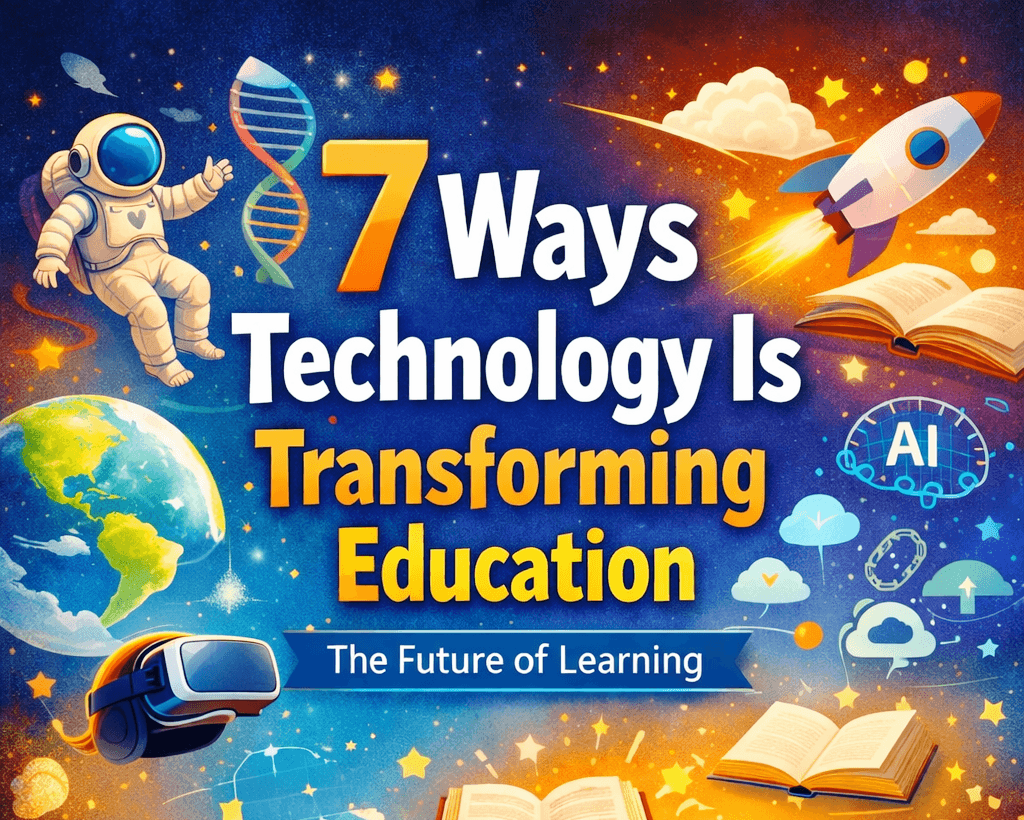
In this article, we’ll explore 7 ways technology is transforming education on a global scale. Each section below delves into a specific trend from online education platforms to immersive virtual reality experiences illustrating how it’s changing the classroom experience. Whether you’re a student, teacher, or edtech professional, these examples will highlight what the future of learning looks like in an increasingly digital world.
1. Smart Classrooms and Digital Learning Tools
One of the most visible changes in schools is the rise of smart classrooms. Gone are the days of solely relying on chalkboards and overhead projectors. Many modern classrooms now feature interactive whiteboards, digital projectors, and even tablets for students. In a smart classroom, teachers can incorporate videos, animations, and other multimedia into lessons, turning traditionally static lectures into dynamic, visual learning experiences. For example, instead of reading about the solar system from a textbook, students might watch a simulation of planets orbiting the sun on a big interactive screen.
These digital tools make learning more engaging and can cater to different learning styles. Visual learners benefit from rich graphics and videos, while interactive quizzes on student tablets can keep everyone involved. Teachers also use educational apps and software to track attendance, instantly poll the class for understanding, or present live quizzes and get immediate feedback. Across the globe, schools are adopting smart classroom setups from high-tech academies in urban centers to pilot programs bringing tablets into rural schools all with the goal of enhancing student engagement and understanding. By integrating technology seamlessly into the classroom, smart classrooms empower teachers to deliver content in more relatable ways and help students participate actively in their own learning.
2. E-Learning and Online Education
Technology has broken down the walls of the classroom through the advent of online learning. Students no longer need to be physically present in a specific school to access quality education. With a computer or even just a smartphone, anyone can join virtual classes or online education platforms from anywhere in the world. This shift to e-learning became especially evident during the COVID-19 pandemic, when millions of students and teachers turned to platforms like Zoom, Google Classroom, and Microsoft Teams to continue their studies from home. Now, even beyond those emergency measures, online learning has become a permanent fixture in education.
The rise of massive open online courses (MOOCs) and learning platforms such as Coursera, edX, and Khan Academy has made it possible for learners to take courses offered by top universities or experts across the globe. A high school student in India can take a coding course from a professor in the United States, or an adult learner in Brazil can watch lectures from a European university all through the internet. Online education offers flexibility: students can often learn at their own pace and on their own schedule, which is a huge benefit for those juggling other responsibilities or for those who learn better outside a traditional 8 to 3 school day. It’s also creating more equal opportunities; for instance, someone in a remote area with few local resources can still access libraries of online tutorials and even earn certificates or degrees online.
Importantly, digital learning tools used in online education like discussion forums, interactive quizzes, and instant feedback on assignments help mimic many benefits of a classroom environment. A student who didn’t understand a lesson in real time can replay a recorded lecture later, and class discussion boards enable asking questions or sharing ideas with peers and instructors. Surveys worldwide indicate that a large share of students would like to continue with some form of online or hybrid learning even as schools reopens. All these signs point to online education continuing to expand, complementing traditional schooling and making learning more inclusive and reachable for people everywhere.
3. Personalized Learning with Artificial Intelligence
Not so long ago, classroom instruction tended to follow a one-size-fits-all model. Today, artificial intelligence (AI) is changing that by enabling personalized learning experiences. AI in education comes in many forms. One common application is adaptive learning software platforms that adjust the difficulty or focus of content based on an individual student’s performance. For example, if a student is practicing math problems online, an AI-driven system can identify which types of problems the student finds challenging and then provide extra exercises in those areas, ensuring the student gets the specific practice they need. Conversely, topics the student has already mastered might be skipped or revisited at a more advanced level, preventing boredom.
AI tutors and chatbots are also emerging as learning tools. These are programs that can answer students’ questions in real-time or walk them through a concept step-by-step, almost like a virtual teaching assistant. Imagine doing homework and being able to ask a question to an AI tutor at any hour this is already happening with some educational apps, where a student stumped on a chemistry problem at 9 PM might get guidance from an AI chatbot. AI can also help teachers by automating routine tasks such as grading multiple-choice quizzes or sorting through homework answers, freeing up educators to spend more time on one-on-one mentoring and creative lesson planning.
Some schools are even experimenting with AI-driven analytics dashboards that analyze test results or student engagement data to spot patterns for instance, an algorithm might alert a teacher that the class is collectively struggling with a certain chapter, prompting a review session.
The result of integrating AI is a more personalized learning journey for each student. Struggling learners can get customized support, while advanced learners are continually challenged with new material. This tailored approach helps keep students motivated because they learn at a pace and in a style that suits their needs. It’s worth noting that AI is a supplement to teachers, not a replacement the goal is to assist educators in understanding student needs better and to provide every learner with a more individualized experience. As AI technology continues to improve, we can expect even smarter tutoring systems and data-driven insights to become commonplace, further transforming how learning is delivered and optimized for each student.
4. Gamification and Interactive Learning
Who says learning can’t be fun? Gamification is the trend of integrating game-like elements into education, and it’s proving to be a powerful way to boost student engagement. In a gamified learning environment, students might earn points, badges, or other rewards for completing tasks or hitting academic milestones. There may be leaderboards to spark friendly competition, or levels to “level up” as learners master new skills. These elements tap into the natural human love for games and achievement, motivating students to participate and keep pushing forward.
For example, many language-learning apps like Duolingo turn vocabulary and grammar practice into a game. Learners get immediate feedback, collect points for correct answers, and maintain “streaks” for practicing several days in a row. In classrooms, teachers use platforms like Kahoot. or Quizizz to create quiz games out of review sessions students become much more enthusiastic about a quiz when they’re racing to answer questions against their classmates in real time. Even traditionally dry subjects can be enlivened with gamification: a history teacher might set up a scavenger hunt for facts where students earn badges for finding key information, or a math teacher could use a puzzle-based game that students solve to unlock the next level of problems.
The benefits of gamification go beyond just having fun. By making learning interactive and competitive in a friendly way, gamified lessons can improve knowledge retention and encourage active participation. Students often report feeling more motivated and less afraid of making mistakes in a gamified setting, because the environment feels like play. There is also evidence that gamification can lead to better outcomes for instance, classes that incorporate game elements often see higher participation rates and even improved grades compared to more traditional teaching methods. The key is that by turning learning into a game, technology helps students focus on continuous improvement and enjoy the process of gaining new skills, rather than seeing it as a chore.
5. Collaboration and Cloud-Based Learning
Another transformative aspect of technology in education is how it enables collaboration beyond the classroom walls. In the past, a student’s group work or interaction was mostly limited to classmates in the same room. Now, with cloud-based tools and collaborative apps, students and teachers can connect and work together whether they’re in the same building or halfway across the world. Platforms like Google Workspace (Docs, Slides, Sheets) allow multiple students to work on a project document simultaneously, in real time, from different devices and locations. It’s common now for a group of students to be jointly editing a shared Google Doc or slide presentation for a project, each contributing their part from home or wherever they are.
Video conferencing and virtual meeting tools have also become staples of modern learning. A class in one country can easily have a live joint session with a class in another country, enabling cultural exchange and collaborative projects across borders. For example, a science classroom in Canada could partner with a classroom in Kenya for a project on climate change, using Zoom or Microsoft Teams to discuss their findings face to face despite being thousands of miles apart. Such experiences were logistically difficult in the past, but technology has made these “global classrooms” possible. Even within a single school, teachers often invite guest speakers or experts to join the class via video call, enriching the curriculum without the need for travel.
Cloud-based learning also means that educational resources (notes, slides, assignments, etc.) are accessible 24/7. Students who miss a class can catch up easily by accessing materials online. Teachers can post updates or additional resources instantly for the whole class to see, and they can use learning management systems to distribute homework or practice quizzes. The cloud supports real-time feedback and assessment as well: educators can see when a student submits work, provide comments or grades online, and students receive that feedback immediately. In many ways, these collaborative technologies help teach students valuable skills like teamwork, communication, and digital literacy all critical in today’s interconnected world. By leveraging cloud platforms, education has become more flexible and connected, ensuring that learning can continue beyond the confines of a single classroom or school day.
6. Virtual and Augmented Reality for Immersive Learning
Few technologies feel as futuristic or as exciting as virtual reality (VR) and augmented reality (AR) in the classroom. These tools create immersive learning experiences that can transport students to places and times they could never access otherwise. VR typically involves wearing a headset that immerses the user in a 3D virtual environment, while AR overlays digital information onto the real world (often through a tablet or smartphone camera view). Both have unique, powerful applications in education.
Consider virtual reality first: With VR, students can take virtual field trips without ever leaving the classroom. Imagine putting on a VR headset and walking through ancient Rome, exploring the surface of Mars, or diving deep into the ocean to study marine life. Schools around the world have begun using VR to supplement lessons for instance, a middle school might use VR to let students virtually visit the Louvre Museum in Paris or go on a tour of the Great Barrier Reef when learning about marine biology. This kind of immersion not only makes learning more engaging, but it also helps students understand and remember concepts better by experiencing them almost first-hand. In places where students normally have limited opportunities to travel (due to location or budget constraints), virtual field trips via VR are opening up the world in an accessible way.
Augmented reality, on the other hand, adds a layer of interactivity to the real world. With AR apps, students can point a device at an image or object and see extra information or 3D models appear on the screen. For example, an AR application can turn a textbook illustration of the human heart into a rotating 3D model, which a student can explore from all angles. A chemistry teacher might use AR to let students visualize molecules floating above their lab tables. AR doesn’t require expensive headsets often a standard smartphone or tablet is enough which makes it relatively easy for many schools to implement. By using the devices many schools already have, AR can add interactive excitement to subjects like science, history, and art without a steep cost.
Both VR and AR make learning far more interactive and experiential. Abstract concepts or distant locations become more tangible when students can virtually experience them. Learners often find these technologies thrilling, which in turn increases enthusiasm for the subject matter. A biology student who can examine a cell in 3D or a history student who can witness a simulation of an ancient civilization will likely have a deeper understanding than they would from text alone. As VR and AR equipment becomes more affordable and content libraries expand, more classrooms globally are likely to incorporate these tools. They represent a peek into the future of education, where students can step inside an environment or concept and learn by exploring, not just by reading about it.
7. Blockchain Technology for Secure Credentials
The influence of technology in education isn’t limited to teaching methods it also extends to how academic records are managed. An emerging development in this area is the use of blockchain technology to secure educational credentials. Blockchain, which underpins cryptocurrencies like Bitcoin, is essentially a decentralized digital ledger that is extremely difficult to tamper with. In education, it’s being used to create secure, verifiable digital records of student achievements essentially a more reliable and tamper-proof way to issue and verify diplomas, certificates, and transcripts.
Educational institutions are increasingly experimenting with blockchain to manage academic credentials more efficiently. By using blockchain, universities can issue digital diplomas and transcripts that have unique cryptographic signatures. Once an academic record is added to the blockchain, it cannot be altered or faked without everyone knowing. This means an employer or another school can instantly verify that a digital diploma or transcript is authentic and hasn’t been modified, simply by checking it against the blockchain record. The verification process, which used to involve manual requests and waiting for paper transcripts, becomes almost instantaneous and fraud-resistant.
Some universities around the world have already started pilot programs for issuing blockchain-based credentials. For example, a graduate might receive a digital version of their diploma that they can share with employers, and the employer can independently confirm its validity online. This innovation reduces administrative overhead (no more chasing down paper records) while increasing trust in the verification process, especially important in a global job market where verifying international credentials can be complex. It also paves the way for a “lifelong learning passport,” allowing individuals to maintain a secure, comprehensive record of all their learning achievements from degrees to professional certifications in one place. While the use of blockchain in education is still in its early stages and will require common standards and cooperation among institutions, it hints at a future where academic qualifications are portable, quickly verifiable, and protected against fraud no matter where you go.
Conclusion
Technology is transforming education in countless ways. From making classrooms more interactive and expanding learning beyond school walls, to personalizing instruction and even securing academic records, technological innovations are reshaping nearly every aspect of education. These changes are happening worldwide, opening new opportunities for learners and educators everywhere. However, with this transformation comes the responsibility to ensure all students have access to these tools (so no one is left behind) and that teachers are supported in using them effectively.
Overall, the impact of educational technology has been overwhelmingly positive, making learning a more engaging and accessible journey. When used thoughtfully, tech amplifies good teaching practices and keeps students at the center of the learning process. With continued innovation and careful implementation to address challenges technology will no doubt keep transforming education for the better in the years ahead.
Frequently Asked Questions
How is technology transforming education?
Technology is expanding access through online education, improving engagement with digital learning tools in smart classrooms, and enabling more personalized learning through AI-driven support and analytics.
What are the main benefits of educational technology for students?
Educational technology supports flexible learning from anywhere, provides faster feedback through digital platforms, and strengthens collaboration and digital skills that are essential for modern careers.
Is online education as effective as in-person learning?
Online education can be just as effective when the course is well-structured, interactive, and supported by active teaching. Many students find blended learning (a mix of online and in-person) especially effective because it combines flexibility with direct classroom support.
How does AI support personalized learning?
AI helps by adapting lessons to a student’s pace, identifying weak areas that need improvement, and offering instant feedback or tutoring-style assistance to guide learning step by step.
What is gamification in education and why does it work?
Gamification applies game elements such as points, progress tracking, and challenges to learning. It works because it increases motivation, encourages consistent practice, and makes lessons feel more engaging and rewarding.
How do cloud-based tools help teachers and students?
Cloud tools allow students to collaborate on the same work in real time, give teachers a faster way to distribute materials and provide feedback, and make learning resources accessible across devices anytime.
How are VR and AR used in education?
Virtual reality enables immersive experiences like virtual field trips and simulations, while augmented reality overlays 3D models and interactive information onto real-world views. Both make complex topics easier to visualize and understand.
What are the biggest challenges of using technology in education?
Common challenges include unequal access to devices or the internet, the need for teacher training, and risks related to distractions, data privacy, and cybersecurity.
How can teachers use technology without overwhelming students?
Teachers can focus on a small set of reliable tools, use technology to support clear learning goals rather than replace instruction, and balance screen-based activities with offline practice and discussion.
How does blockchain help in education?
Blockchain can store credentials like diplomas and certificates in a secure, tamper-resistant format. This makes verification faster, reduces fraud, and supports portable records that can be shared globally.