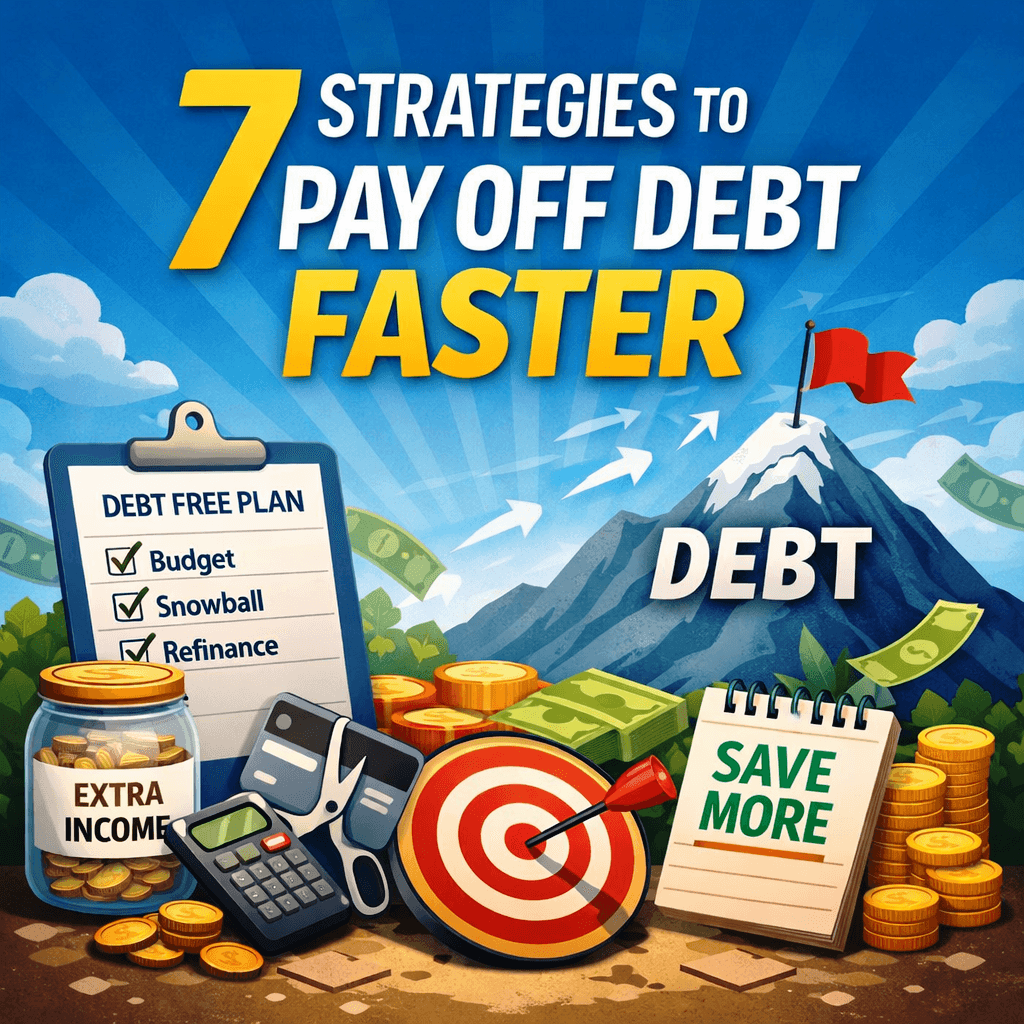
Debt can feel like a heavy burden holding you back from your financial goals. If you’re struggling with loans, credit cards, or other debts, you’re not alone. Americans collectively owed over $18 trillion in 2025, with the average credit card balance around $6,700. The good news is that with a solid plan and a bit of discipline, you can become debt-free faster than you might imagine. There are several proven debt repayment strategies that can speed up your progress. Some focus on saving money on interest, while others give you quick wins to stay motivated. In this blog post, we’ll cover seven actionable strategies to pay off debt faster. These tips are geared toward a general audience from young professionals to families and we’ll keep the tone conversational and motivating. Let’s dive in.
1. Create a Budget and Stick to It
One of the first steps toward paying off debt faster is creating a realistic budget. A budget is simply a plan for where your money goes each month. By tracking your income and expenses, you can identify how much money you can free up for debt payments. In fact, more than 86% of people say they budget regularly, and 84% of those report that budgeting helped them avoid or pay off debt. This shows that having a budget can directly support your debt repayment goals.
How to budget
Start by listing all your monthly expenses (rent/mortgage, utilities, groceries, insurance, etc.) and compare them to your take-home income. Allocate specific amounts for each category, including a portion for debt repayment. A popular guideline is the 50/30/20 rule spend 50% of income on needs, 30% on wants, and 20% on savings or debt repayment. You can also try other methods like zero-based budgeting or the envelope system. The key is to find a budgeting style that works for you and stick with it.
Use technology
Take advantage of budgeting tools or apps to make this easier. Apps like Mint, YNAB (You Need A Budget), or PocketGuard can link to your accounts, track your spending, and help you visualize where your money goes. Many banks also offer budgeting features in their online banking. If you prefer spreadsheets, that works too choose whatever you’ll actually use consistently.
Make debt a priority
Be sure to include your debt payments as a “must-pay” category in your budget. Treat it like an important bill. For example, if you normally pay $200 in credit card minimums, budget a bit more (say $250 or $300 if possible) as a fixed “payment” to yourself that goes straight to debt. By planning for larger payments, you’re less likely to spend that money elsewhere.
Stay flexible and adjust
After a month or two, review your budget. You might find areas where you overspent or underspent. That’s okay adjust the numbers and keep going. The goal is to ensure you consistently spend less than you earn so that the surplus can go toward knocking down your balances. Building a budget might feel tedious at first, but remember, a budget is your blueprint for becoming debt-free it gives you control and confidence in your finances.
2. Pay More Than the Minimum Payment
Credit card companies and lenders love it when you pay only the minimum it means you’ll be in debt for a very long time while interest piles up. To pay off debt faster, a crucial strategy is to pay more than the minimum payment whenever possible. Even small extra payments can shave years off your repayment timeline and save you a lot in interest.
The minimum payment trap
Minimum payments are usually a tiny percentage of your balance (often 2 to 3% for credit cards). If you only pay that amount, the remainder continues accruing interest. For example, one scenario showed that if you only make minimum payments on about $14,700 of credit card debt at ~13% APR, it could take 31 years to pay it off completely and cost over $16,000 in interest. In contrast, increasing your payment to $300 per month would wipe out that debt in about 6 years (with roughly $6,425 in interest), and paying $600 per month could eliminate it in just 2 years (with only about $2,493 in interest). The takeaway is clear: paying just a little extra each month can dramatically speed up your debt payoff.
Actionable tips
1. Round up your payments
Instead of paying an odd figure like $257 as a minimum, round it up to $300 if you can. That extra $43 might not seem like much, but over time it makes a big difference.
2. Bi-weekly payments
If you have the option, consider splitting your monthly payment in half and paying every two weeks. This results in 26 half-payments (or 13 full payments) in a year instead of 12, effectively giving you one extra monthly payment per year applied to the principal.
3. Use windfalls wisely
Whenever you get unexpected money a tax refund, bonus, gift, or even selling unused items consider putting a chunk of it toward your debt. Making a lump-sum extra payment can knock down your balance immediately.
4. Automate extra payments
If possible, set up an automatic transfer to your debt account right after each payday, above the minimum amount. Paying yourself (toward debt) first ensures you won’t accidentally spend that money elsewhere.
Real-world motivation
Every extra dollar counts. One person who eliminated her debt said she became almost obsessed with sending any spare cash to her student loan, even small amounts from side gigs, and she would eagerly calculate how each tiny payment shortened her debt-free date. You can do the same: try using an online debt payoff calculator to see how an extra $50 or $100 a month will impact your payoff timeline. Watching that debt-free date move closer can be incredibly motivating.
3. Use the Debt Snowball Method (Small Wins First)
When you have multiple debts, deciding how to allocate your payments can be tricky. One popular debt repayment strategy is the Debt Snowball method, which focuses on knocking out the smallest balances first. This method is all about building momentum and motivation through quick wins.
How the debt snowball works
List all your debts and order them from the smallest balance to the largest. Ignore the interest rates for now. Continue paying the minimum on all debts except the smallest one throw any extra money you have at that smallest debt until it’s paid off. For example, if your smallest debt is a credit card with a $500 balance, focus on paying that off aggressively while paying minimums on larger loans. Once the $500 debt is gone, you “snowball” that payment into the next debt. In other words, take the money you were putting toward the first debt (the amount of its minimum plus any extra you were paying) and add it to the payments on the next-smallest debt on your list. As you eliminate each balance, the amount you can apply to the next debt grows like a snowball rolling downhill gathering size.
Why it works
The strength of the snowball method is psychological. You get quick wins. Paying off the smallest debt gives you a sense of accomplishment early on. It feels great to cross a debt off your list, and that boost can encourage you to keep going. Many people find that these early successes provide the motivation they need to stick with their debt payoff plan. This is especially helpful if you’ve struggled in the past to stay committed to a long-term financial goal.
Example
Suppose you have three debts: a $700 medical bill, a $2,000 credit card, and a $10,000 student loan. With the snowball approach, you’d focus on the $700 medical bill first. Maybe you can pay an extra $100 a month on it and clear it in a few months. Once it’s paid, you feel accomplished one down. Next, take the amount you were paying on that medical bill and add it to what you were paying on the credit card. Now you’re paying more towards the $2,000 balance, so it disappears faster. Finally, all the money that was going to the first two debts is now supercharging payments on the student loan. You’ve essentially created a debt snowball that gets larger as each obligation is paid off.
Keep the momentum
To get the most from the snowball method, stay engaged with your progress. Track how many debts you’ve paid off and how much closer you are to freedom. Some people use visual aids like a chart on the fridge coloring in each $100 of debt paid to see the progress. Celebrate small milestones (in inexpensive ways) to reward yourself for each victory. Remember, the goal is to maintain motivation. Quick wins can propel you forward on your journey to becoming debt-free.
4. Use the Debt Avalanche Method (High-Interest First)
While the snowball method prioritizes small balances, the Debt Avalanche method prioritizes interest savings. With the avalanche, you pay off debts in order of highest interest rate to lowest, which can save you money in the long run and potentially get you out of debt faster overall (especially if you have large high-interest debts).
How the debt avalanche works
List all your debts, this time ordered by interest rate, from highest rate to lowest. You’ll focus on the debt with the highest interest first, regardless of its balance. Continue making minimum payments on all debts, but put any extra repayment money toward the highest-interest debt. For example, if your highest rate debt is a credit card at 22% APR, pay that off first, because it’s costing you the most in interest each month. Once that top debt is paid, move to the next-highest rate on your list, and so on. Over time, this method wipes out the most expensive debt first, which can save you significant interest costs compared to other methods.
Why it works
The avalanche method is mathematically efficient. By attacking the highest-interest debt, you eliminate the costliest balance first, which means more of your money goes toward principal on the remaining debts (rather than being eaten up by interest charges). This can lead to paying less interest overall and potentially a quicker payoff period than the snowball, especially if your largest balances also carry high rates. If your primary motivation is to save money and you’re less concerned with quick emotional wins, the avalanche is a great choice.
The trade-off
The challenge with the debt avalanche is that you might not see a balance disappear as quickly as with the snowball method. If your highest-interest debt is also a large balance, it could take a while to fully pay off that first account. Some people might feel frustrated or impatient waiting many months (or even years) to eliminate the first debt. That’s where the classic debt snowball vs. avalanche debate comes in it’s motivation vs. math. Both methods work; the best one is the one you can stick with. As one financial expert noted, the avalanche method can save you more money “by wiping out the costliest debt first,” but if quicker wins would motivate you more, the snowball may be a better method.
Tips for using the avalanche
- Make sure you stay engaged with your plan even if progress feels slow at first. Track how much interest you’re avoiding by using this method that can be motivating in itself. For example, you could calculate “Using the avalanche on my $5,000 credit card at 20% is saving me X dollars in interest every month compared to if I only paid the minimum.”
- If it helps, break a large debt into sub-goals. Say you have a $15,000 loan at 18%. Set milestones like “Pay off $3,000 (20%) by June” or “Get the balance under $10,000” by a certain date. This gives you intermediate targets to celebrate.
- Remind yourself of your “why” perhaps it’s to stop wasting money on interest and put those dollars towards a house or an emergency fund instead. Keeping the end goal in mind (financial freedom and security) will help you push through.
Choosing your method
Ultimately, whether you choose snowball or avalanche, you need a strategy you’ll stick with. If you know you need positive reinforcement to stay on track, the debt snowball’s quick wins can be empowering. If you’re more motivated by logic and the desire to minimize costs, the debt avalanche might suit you better. There’s no wrong choice some people even combine the two (for example, start with a snowball to gain momentum, then switch to an avalanche to finish off the rest). The key is to pick a plan and commit to it. As long as you’re making consistent progress, you’re moving in the right direction toward being debt-free.
5. Consolidate or Refinance Your Debt
If you’re juggling multiple high-interest debts, another strategy to pay them off faster is to consolidate or refinance those debts into one with a lower interest rate. The idea is simple: if you can reduce the interest you’re paying, more of your payment goes toward the principal balance, which helps you get out of debt sooner.
What is debt consolidation?
Debt consolidation means combining several debts into a single new loan or credit line. For example, you might take out a debt consolidation loan (such as a personal loan) or open a balance transfer credit card and use it to pay off all your other accounts, leaving you with just one monthly payment. Ideally, this new loan has a lower interest rate than your old debts. By doing this, you can save money on interest and possibly shorten your payoff timeline. Consolidation can also simplify your life it’s easier to remember one due date instead of five.
Options for consolidating/refinancing
1. Personal loan
Many banks, credit unions, or online lenders offer personal loans specifically for debt consolidation. If you have a decent credit score, you might qualify for a loan with a lower APR than your credit cards. You then use that loan to pay off the cards, and repay the loan in fixed installments over a set term (often 2 to 5 years). Tip: Shop around and compare rates, terms, and any origination fees before choosing a loan. Only proceed if the new loan’s interest rate and fees make it cheaper than staying with your current debts.
2. Balance transfer credit card
Some credit cards offer a 0% APR promotional period (often 12 to 18 months) for balances transferred from other cards. This can be a great way to eliminate interest temporarily. If you can transfer, say, a $5,000 balance from a 20% interest card to a 0% card, and then aggressively pay it down during the promo period, you’ll save a lot in interest. Caution: Usually there’s a balance transfer fee (around 3 to 5%), and if you don’t pay off the balance by the end of the promo, the rate jumps to the regular (often high) APR. So this tactic works best if you have a clear plan (and budget) to wipe out that transferred balance in time. Also, avoid adding new purchases on the new card, as those might not benefit from the promo rate.
3. Refinancing loans
If your debt is in the form of loans (like a student loan, auto loan, or mortgage), refinancing means taking out a new loan at a lower rate to replace the old one. For example, homeowners sometimes refinance mortgages to get a lower rate, which frees up cash flow. Similarly, you might refinance a high-interest private student loan to a lower-rate loan, or an auto loan if interest rates have dropped or your credit improved. Lowering your rate can help you pay the loan off faster if you continue making the same payments as before. If refinancing gives you a lower monthly payment, consider still paying the old amount the difference will go toward principal and shorten the loan term. Keep in mind refinancing can come with its own costs or extend terms, so weigh the pros and cons and read the fine print.
Important considerations
Consolidation isn’t a magic fix you still have the debt, just in a different form. It works best when you’re disciplined about not accumulating new debt. Before consolidating, ensure you’re not simply freeing up credit cards only to run them up again. Also, factor in any fees and the length of the new loan. Sometimes consolidation can extend your repayment timeline; to pay off faster, you’ll want to pay at least as much as you were paying before (if not more). The goal is to reduce interest or payments so you can attack the principal harder.
Real-world example
One individual had about $80,000 across student loans, car loans, and credit cards. He felt overwhelmed and was even missing payments. He decided to work with his credit union to consolidate some of his high-interest credit card debt into a personal loan at a much lower rate. This gave him a clear plan: a fixed loan payment each month and fewer bills to juggle. With the lower interest and a focused approach (and by still paying extra when possible), he managed to pay off all his debt in just over three years. His story shows that, used wisely, consolidation can jumpstart your debt-free journey.
If you’re not sure whether consolidation or refinancing makes sense for you, consider talking to a nonprofit credit counselor or using an online debt payoff calculator. And remember the rule of thumb: only consolidate if it truly lowers your interest or helps you pay off debt faster. When done right, this strategy can simplify your payments and accelerate your path to zero debt.
6. Increase Your Income with Side Hustles or Overtime
Cutting expenses is one side of the coin in freeing up money for debt; the other side is increasing your income. There’s a limit to how much you can trim from your budget, but your earning potential can be more flexible. Earning extra money even temporarily can provide a significant boost to help pay off debt faster.
Why earning more helps
It might sound obvious, but the more money you have available, the more you can put toward your balances. If you can generate an additional $200 a month and apply it all to your debt, that’s $2,400 in a year of extra progress (plus saved interest). Every bit of extra income accelerates your debt payoff timeline. As one person who crushed her debt put it: Cutting your budget is great, but there’s only so much you can cut. You can always try to make more money. In her case, she picked up several side hustles and greatly sped up her debt payments.
Ideas for boosting income
Think about skills or opportunities you have. Here are a few possibilities:
1. Side hustles
These can be gigs like freelance work (writing, graphic design, coding, consulting), driving for rideshare or delivery services (Uber, Lyft, DoorDash), tutoring, pet sitting or babysitting, selling crafts on Etsy, etc. The gig economy is huge, and you can often find something that fits your schedule.
2. Part-time job or overtime
If your schedule allows, a part-time job on evenings or weekends can funnel money directly to debt. Alternatively, if your current job offers overtime or extra shifts, taking those on for a period of time can help. It might mean sacrificing some free time in the short term, but remember it’s temporary and for a good cause.
3. Monetize hobbies or assets
Do you have a hobby that could earn money? Maybe you take great photos consider selling stock photography, or you’re handy with crafts sell products online or at local fairs. If you have a car you’re not using much, you could rent it out on a platform like Turo. If you have a spare room, platforms like Airbnb could bring in cash. Get creative based on your situation.
4. Ask for a raise or new job
Don’t overlook the long-term solution of increasing your primary income. It might not be immediate, but negotiating a raise at your current job or seeking a higher-paying position can improve your finances sustainably. Any salary bump can accelerate debt payoff (just avoid lifestyle inflation and put the extra toward debt).
Make it sustainable
Earning extra is great, but burnout is real. If you take on a side hustle, set a timeframe or a specific goal (e.g., “I’ll do this for 6 months” or “until I pay off $5,000 of debt”). Knowing it’s not forever can keep you motivated. One young professional managed a grueling 100 hour workweek by juggling a full-time job plus multiple side gigs (blogging, selling items, online surveys) when she had $38,000 of student loans to repay. It was tough, but she stayed motivated by watching her debt balance drop each month. You don’t necessarily have to go to that extreme, but her story shows how powerful the combination of high motivation and extra income can be.
Remember to channel all of your extra earnings into your debt payoff. It can be tempting to spend that hard-earned side hustle money on treats (and it’s okay to reward yourself occasionally), but try to keep your eyes on the prize. Even if you dedicate 90% of your extra income to debt and keep 10% for fun or savings, you’ll make headway. Increasing your income is like giving your debt payoff plan a turbo boost use it wisely and you’ll be debt-free even sooner.
7. Cut Unnecessary Expenses and Spending
We’ve talked about budgeting and making a plan for your money. Now it’s time to take a hard look at your expenses and cut out anything unnecessary. Trimming your spending frees up extra cash that you can throw at your debt, accelerating your payoff. Think of it as finding money within your existing income.
Identify your “wants” vs. “needs”
Go through your monthly expenses and identify things that are not essential. You might be surprised how the “little” things add up. Do you really need all those streaming service subscriptions? Are you paying for a gym membership you rarely use? Is dining out or ordering takeout eating up a big chunk of your budget? Be honest with yourself about what expenses truly bring value to your life and which you can live without, at least while you’re focusing on debt. Align your spending with your values if an expense isn’t that important to you, cutting it will hurt a lot less than staying in debt.
Easy places to cut or save
1. Subscriptions and memberships
Cancel or pause any subscriptions you’re not actively using. This could be streaming services, magazines, monthly boxes, or that gym membership. Even if each is “only” $10 or $20 a month, together they could free up $50 to $100 monthly for debt payoff.
2. Cooking at home
Reduce how often you eat out or get coffee/shop drinks. Meal prepping and cooking at home can save a significant amount. For example, if you currently spend $15 a day on lunch and coffee, cutting that to $5 by packing lunch could save ~$200 a month.
3. Entertainment on a budget
Look for free or low-cost alternatives for fun. Instead of pricey concerts or movies, try local free events, game nights with friends, or streaming a movie at home. You don’t have to eliminate fun; just spend less while still enjoying life.
4. Utilities and bills
Shop around or negotiate for better rates on services like your cell phone plan, internet, or insurance. A quick call to your provider asking for a lower rate or checking competitor prices can often result in savings. Many companies have loyalty discounts or promotions if you ask.
5. Energy and groceries
Simple habits like turning off lights, unplugging electronics, or using a programmable thermostat can shave a few dollars off your utility bills. Couponing or buying store-brand groceries in bulk can also reduce your monthly costs.
Every dollar you shave off your regular expenses is a dollar freed to pay down debt. Every little bit counts even a $20 reduction in your monthly bills, put toward a credit card balance, makes a difference over time. Consider trying a “no-spend challenge” for a week or a month, where you commit to not spending on anything outside of absolute necessities. Challenges like these can reset your spending habits and jump-start your savings.
Stay mindful, not miserable
Cutting expenses doesn’t mean you never have fun or treat yourself; it means being intentional with your spending. If daily lattes are your joy, maybe you keep that and cut elsewhere the key is to trim things that don’t matter as much. One family discovered they had been spending extravagantly to keep up appearances (luxury cars, shopping sprees) and ended up $40,000 in debt. They felt little true happiness from those expenses. Once they refocused on what really mattered (quality time, financial security), they downsized their lifestyle dramatically and paid off their debt. You might not have such a drastic story, but the principle stands: when you cut out the spending that isn’t important, you regain control and can direct your money to what is important in this case, eliminating debt and building a secure future.
Finally, as you cut costs, be sure to apply those savings to your debt. It’s easy to say “I saved $100 on my cable bill, now I have $100 extra,” but if you don’t purposefully send that $100 to your creditor, it might just get spent elsewhere. Treat your savings like any other income budget it or automate it toward your loans or credit cards. Over time, these cuts and adjustments become new habits, and you might find you don’t miss the things you gave up. Especially when you see your balances shrinking faster each month, the sacrifice will be well worth it.
Conclusion
Becoming debt-free is a journey, and every journey starts with a single step. We’ve covered seven strategies from budgeting, debt snowball vs. avalanche methods, and consolidation, to boosting income and cutting expenses that can help you pay off debt faster and more efficiently. These strategies are not mutually exclusive; in fact, you can combine several of them. For example, you might use the debt avalanche method while also picking up a side gig and trimming your budget. Find the mix that works for your life and keeps you motivated.
Remember, the path to becoming debt-free is as much about mindset as it is about math. Stay focused on your “why” whether it’s to relieve stress, provide a better future for your family, or simply to stop paying interest and start building wealth. There will be challenges and maybe the occasional setback (life happens!), but don’t let those discourage you. Each payment, each sacrifice, each smart decision is a step forward.
Now is the best time to start. Take a look at your finances and pick one strategy from this list to put into action today. Maybe set up a budget, or call to negotiate a bill, or list an old item for sale even a small move can build momentum. Over 84% of people say budgeting helped them get out or stay out of debt imagine what you can accomplish with budgeting and these other strategies combined.
You have the power to take control of your debt and write a new financial story. It won’t always be easy, but as you see those balances go down, you’ll feel the weight lifting. Stay motivated, keep your eye on that debt-free future, and don’t be afraid to celebrate milestones along the way (in a budget-friendly way, of course). You’ve got this. Start now, and every day you’ll be closer to the freedom of a debt-free life. Let’s conquer that debt your future self will thank you.
Financial Disclaimer
The information provided on this blog is for educational and informational purposes only and should not be considered financial, investment, tax, or legal advice. All content is general in nature and may not apply to your individual circumstances.
While we strive to keep the information accurate and up to date, we make no warranties or guarantees regarding completeness, reliability, or accuracy. Any actions you take based on the information on this blog are strictly at your own risk.
Before making any financial decisions, you should consult a qualified professional who can consider your specific goals, income, risks, and personal situation.
Frequently Asked Questions
What is the fastest way to pay off debt?
The fastest way is typically to free up cash with a realistic budget, pay more than the minimum every month, and follow a structured payoff method (either snowball or avalanche). If you can also lower your interest rates through refinancing or consolidation, or bring in extra income, your payoff timeline usually shortens significantly.
Should I pay off debt or save money first?
Many people do best with a hybrid approach: build a small starter emergency fund first so unexpected expenses don’t go back on a credit card, then prioritize aggressive payments on high-interest debt. If you have an employer retirement match, it often still makes sense to contribute enough to capture the match while paying down expensive debt.
Debt snowball vs. debt avalanche: which is better?
Debt snowball focuses on paying the smallest balances first, which gives quick wins and motivation. While debt avalanche targets the highest interest rate first, which usually saves more money and can be faster mathematically. The better method is the one you will consistently follow for months, not just a few weeks.
How much extra should I pay each month to see real progress?
Even a small amount added consistently can make a difference, especially on high-interest balances. The best number is the largest amount you can commit to without skipping essentials like housing, food, and utilities. A debt payoff calculator can show exactly how an extra amount changes your payoff date.
Is it worth consolidating debt?
Consolidation is worth considering when it lowers your interest rate and simplifies repayment without extending your payoff too far. It becomes a problem if it creates “empty” credit card space and you run balances back up again. Consolidation works best when paired with spending control and a clear plan.
Are balance transfer cards a good idea?
They can be very effective if you qualify for a strong 0% APR promotional period and you can realistically pay the transferred balance off before the promotion ends. Balance transfer fees can reduce the benefit, and the interest rate can become high afterward, so it’s important to do the math and stick to the payoff schedule.
How do I stay motivated while paying off debt?
Motivation improves when progress is visible. Tracking your balances weekly or monthly, celebrating milestones cheaply, and keeping your “why” in front of you can help. If you’re someone who needs fast momentum, the snowball method may make it easier to stay consistent.
Should I stop using credit cards while paying off debt?
If credit cards are part of what created the debt, pausing credit card use is often one of the fastest ways to stop the cycle. Using debit or cash for daily spending can prevent new balances while you’re paying down existing ones. If you keep one card for emergencies, set strict boundaries so it doesn’t become routine spending.
What debts should I pay off first?
High-interest credit card debt is usually the best target because it grows quickly and costs the most. After that, you can prioritize by either interest rate (avalanche) or balance size (snowball). If any debt has serious consequences collections, legal action risk, or loss of essential services it should be addressed quickly and carefully.
How can I pay off debt faster on a low income?
Start with tight control of spending so you can consistently generate a surplus, even if it’s small. Then look for the simplest ways to increase cash flow, such as negotiating bills, cutting subscriptions, or finding a flexible side income stream. If your debt feels unmanageable, asking lenders about hardship programs can also create room to breathe.
Can I negotiate my debt or interest rates?
In many cases, yes. You can call lenders and ask about lower APRs, hardship programs, fee waivers, or alternative payment plans. It’s not guaranteed, but it’s often worth trying because even a small rate reduction can improve your payoff speed.