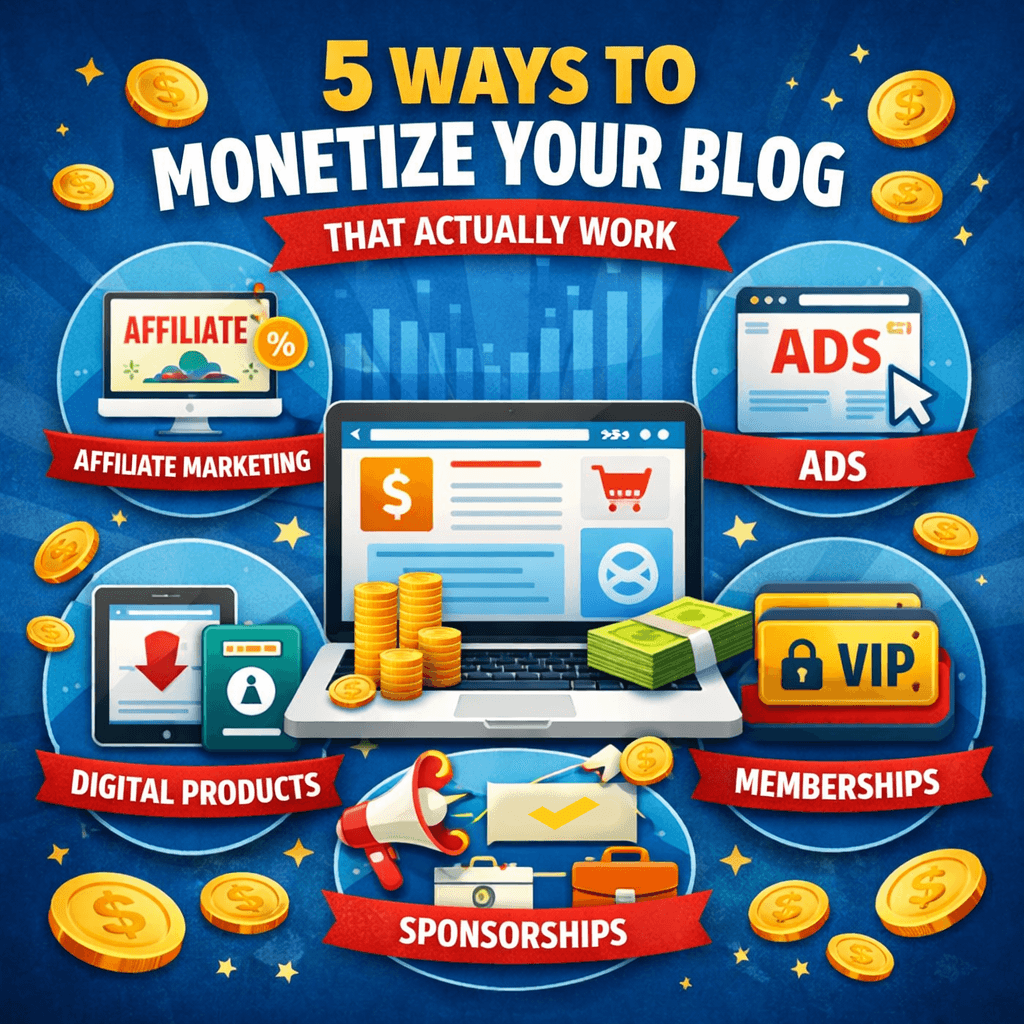
Blogging has evolved from a hobby into a legitimate business model. A blog with consistent traffic can become the engine that powers digital brands and there are more options than ever to turn your content into income. Monetization isn’t about a single magic button; it’s about matching strategies to your niche and audience. Below are five proven monetization methods, explained with practical tips and guidance.
1. Display advertising: turn traffic into passive income
Display advertising remains a classic way to monetize a blog. When you run display ads, you place banners or widgets on your site and earn revenue when visitors view (CPM, cost per thousand impressions) or click (CPC) those ads. The Elementor 2026 guide explains that bloggers typically start with Google AdSense because it’s open to new sites and easy to set up. You paste a snippet of code, and the network automatically serves relevant ads. Although payouts are low, AdSense helps you generate your first dollars without active selling.
For higher earnings, bloggers graduate to premium ad networks such as Mediavine and Raptive (formerly AdThrive). These platforms require substantial traffic e.g., Mediavine needs about 50,000 sessions per month but they partner with premium advertisers, so CPM rates can be five to ten times higher than AdSense. Another guide from Network Solutions notes that you can also sell advertising space directly to companies. While ad networks provide convenience, direct sales let you negotiate better rates and ensure the ads align with your niche. However, direct sales take more work and are best suited to established blogs with a clear audience.
Getting started tips
- Focus on traffic first. Ads pay by views or clicks, so devote your early months to content and SEO before turning on the ads.
- Place ads strategically. Use placements above or within content where they are visible but not intrusive. Don’t over-saturate pages, too many ads will frustrate readers and slow down your site.
- Experiment with networks. Start with AdSense, then apply to Mediavine or Raptive once you hit their traffic requirements. Evaluate the earnings per thousand impressions (RPM) to decide which network suits your blog.
Pros and cons
Display advertising offers a steady, passive income stream once your blog has sufficient traffic. However, it can clutter the user experience and typically requires tens of thousands of pageviews to be meaningful. Furthermore, ad-blocking technology and “ad fatigue” from readers mean that display ads should be just one part of a diversified revenue plan.
2. Affiliate marketing: recommend products you trust
Affiliate marketing allows you to earn a commission when readers buy products or services through your referral links. The Elementor guide calls it a favorite model for new bloggers because it’s trust‑based: you recommend products you genuinely use, insert your unique affiliate link in a post, and earn a percentage when readers make a purchase. Programs like Amazon Associates let you promote almost any product, though commissions are low. Affiliate networks such as ShareASale, CJ Affiliate and Rakuten host thousands of programs across industries. Many software companies and course creators also run their own affiliate programs.
The Network Solutions guide stresses that affiliate marketing is accessible: sign up for a program, get your special link and incorporate it into your content. Bloggers appreciate affiliate marketing because it offers more control than display ads and can provide higher earnings when readers trust your recommendations. Commission rates vary from about 1 to 5% on Amazon to up to 10% for luxury beauty products and fixed commissions (e.g., $150 for each Shopify subscription).
Best practices for high conversions
- Promote only what you use and trust. Authenticity is critical; your audience can sense when you’re just chasing commissions. The Elementor guide emphasizes that the most effective affiliate marketing helps readers first and treats the link as a resource, not a hard sell.
- Create “money” content. Posts that naturally convert include in‑depth reviews, product comparisons and “best of” lists. These formats allow you to highlight pros and cons, link to multiple affiliate partners and answer readers’ questions.
- Disclose your affiliation. The FTC requires disclosure of affiliate relationships. A simple statement at the top or bottom of a post keeps you compliant and transparent.
Why affiliate marketing works
You earn passive income because the tracking link continues to generate commissions long after publication. Over time, you build a library of evergreen posts that rank in search engines and deliver steady traffic and sales. The Printify guide notes that affiliate marketing pairs well with sponsored reviews and can be combined with other strategies. However, it usually requires a sizable, engaged audience and quality content and trust are prerequisites for significant income.
3. Sell your own products: digital and physical
Creating and selling your own products gives you the highest profit margins because you control the pricing and keep most of the revenue. Digital products, in particular, are almost pure profit because there is no inventory, shipping or production cost. The Elementor guide explains that selling your own digital products (ebooks, online courses, templates and printables) has the highest profit margin. An ebook or template can be sold repeatedly after a one‑time creation.
Popular digital products include
- Ebooks: Package your expertise or repurpose blog posts into a downloadable guide.
- Online courses: Use video and worksheets to teach a skill. Platforms such as LearnDash, Teachable and Udemy simplify hosting and payment.
- Templates and printables: Provide website themes, planners or spreadsheets that save users time.
Physical products can also be profitable, especially if they align with your brand. Printify suggests using print‑on‑demand (POD) services to sell custom merchandise without holding inventory: you design branded items like T‑shirts or mugs, and your POD partner prints and ships them for you. This model eliminates upfront costs and risk because products are produced only after a customer orders them.
Tools and platforms
- On WordPress, plugins such as Easy Digital Downloads or WooCommerce provide e‑commerce functionality.
- For digital downloads, platforms like Gumroad and Podia handle payments and file delivery.
- For print‑on‑demand, services like Printify integrate with Shopify, Etsy or WooCommerce.
How to succeed
- Identify a market need. Use your blog analytics or reader surveys to determine what problems your audience wants solved.
- Create high‑quality content. Whether it’s an ebook or a course, invest time in research, design and editing. Your product should feel premium so customers perceive value.
- Use your blog to market the product. Write launch posts, embed banners, collect email leads and run sales promotions. Your existing readership already trusts your expertise, making marketing more effective.
Physical versus digital
Physical products require more logistics and often yield lower margins due to manufacturing and shipping. The Network Solutions guide recommends testing physical products via affiliate or dropshipping links first, and only creating your own merchandise after confirming demand. Start with low‑risk, print‑on‑demand items and transition to your own inventory once you see consistent sales.
4. Memberships and paid communities: create recurring revenue
Membership programs (often called gated content or subscriptions) provide predictable, recurring income. In a membership model, readers pay a monthly or yearly fee for access to exclusive content, resources or a private community. The Elementor guide describes this strategy as the “holy grail” because 200 members paying $10 per month equates to $2,000 in predictable income. Membership sites appeal to your most loyal fans and foster a sense of community.
The Printify article adds that membership blogs can offer exclusive articles, reports, webinars, meetups and networking. Tools like Patreon and Nebula let you host premium content externally, while WordPress plugins like MemberPress or LearnDash integrate paywalls into your site. Some bloggers also add donation buttons (e.g., Buy Me a Coffee or PayPal Donate) to allow voluntary contributions.
Building a membership program
- Develop premium content. Your paid content must be deeper or more valuable than the free posts; examples include in‑depth tutorials, extended case studies or live Q&A sessions.
- Choose the right platform. Use membership plugins if you run a WordPress blog or external platforms like Patreon. Each platform has different fees and features, so evaluate what fits your workflow.
- Price strategically. Consider your audience’s willingness to pay. Offer a low introductory tier to encourage sign‑ups and a higher tier with additional benefits.
- Community engagement. Create forums, Discord servers or private social groups where members can interact. The sense of belonging is part of what they’re paying for.
Benefits and challenges
Recurring revenue gives you financial stability and reduces reliance on ad networks. However, membership programs require regular content updates and strong community management. You need to sustain member interest to minimize churn (cancellations). Additionally, if you gate too much content, you risk alienating new readers who aren’t ready to pay.
5. Sponsored content and brand partnerships: monetize influence
Sponsored content involves creating blog posts, newsletters, videos or social media updates in collaboration with a brand that wants access to your audience. Unlike affiliate marketing where you earn commissions only when sales occur, sponsored posts provide a flat fee upfront. Brands pay to promote their products or services to your readers because they value your credibility and reach. The Elementor guide notes that sponsored content is similar to affiliate marketing but you get paid regardless of sales.
Sponsored content can take many forms: a detailed product review, a “day‑in‑the‑life” feature, a recipe using a brand’s ingredient or a series of social media posts. To secure sponsorships, blogs need high, engaged traffic, a clear niche and a professional media kit with traffic and demographic stats. The Printify guide recommends reaching out to brands proactively and using sponsorship networks like Sway Network or ValuedVoice to connect with potential partners. When working with sponsors, always prioritize your audience’s interests and make sure every brand partnership aligns with your niche and provides value to your readers. Also, disclosure is mandatory: the FTC requires that sponsored posts be clearly labeled.
Steps to land sponsored partnerships
- Build influence first. Focus on growing traffic and engagement. Brands want to see a passionate, targeted audience.
- Prepare a media kit. Include your traffic statistics, social media following, email subscriber count, reader demographics and examples of past collaborations.
- Pitch brands you already love. Authenticity is key. Approach companies whose products you genuinely use or that fit your niche.
- Negotiate rates. Rates vary based on your traffic and influence. Don’t undervalue your work consider asking for both payment and long‑term promotion.
- Follow disclosure rules. Label sponsored posts clearly, and use “no‑follow” tags on sponsored links to comply with Google’s guidelines.
Considerations
Sponsored content can be lucrative and Statista estimated that content creators generated over $8 billion from sponsored content in 2024. However, it is competitive; brands often choose blogs with larger audiences. Maintain your editorial integrity by rejecting partnerships that don’t resonate with your readers. Long‑term brand relationships can lead to repeat collaborations and deeper partnerships, but only if trust remains intact.
Conclusion
Blog monetization requires strategy and patience. Each method outlined above has strengths and limitations. Display advertising offers passive revenue but requires high traffic; affiliate marketing rewards trust and targeted content; selling products yields high margins but demands creation and customer support; memberships deliver steady recurring income but require ongoing value; and sponsored content can be lucrative but depends on your influence and must remain authentic. Rather than relying on a single stream, diversify your monetization mix. Letterhead’s monetization guide suggests that a healthy mix of subscriptions, advertising and digital products creates a resilient business that can withstand market changes.
Above all, keep your audience’s needs at the center of your strategy. The most successful monetization plans grow from a deep understanding of who you’re serving and what they value. Use analytics and feedback to refine your content, test different revenue streams and invest in the channels that resonate most. With thoughtful planning and consistent effort, your blog can become not just a creative outlet but a thriving business.
Financial Disclaimer
The information provided on this blog is for educational and informational purposes only and should not be considered financial, investment, tax, or legal advice. All content is general in nature and may not apply to your individual circumstances.
While we strive to keep the information accurate and up to date, we make no warranties or guarantees regarding completeness, reliability, or accuracy. Any actions you take based on the information on this blog are strictly at your own risk.
Before making any financial decisions, you should consult a qualified professional who can consider your specific goals, income, risks, and personal situation.
Frequently Asked Questions
Can you really monetize a blog with low traffic?
Yes, especially with affiliate marketing, services (freelance/consulting), and digital products. Display ads typically require higher traffic to be meaningful, but selling a service or a targeted product can work with a small, highly relevant audience.
What’s the fastest way to make money from a new blog?
For most beginners, the fastest is offering services (freelancing, consulting, coaching) because you can earn with fewer visitors if your expertise is clear and your offer is high-value. Affiliate marketing can also start early if your content targets buyer-intent searches.
Do I need to disclose affiliate links and sponsorships?
Yes. Use clear disclosures for affiliate links and sponsored content. This is both a compliance and trust issue. Put disclosures near the top of posts and near calls-to-action when appropriate.
How much should I charge for a sponsored post?
Pricing depends on niche, traffic, audience buying power, email list size, engagement, and deliverables (post only vs. post + newsletter + social). A simple approach is to start with a base rate, then adjust as you get results and demand.
How long does it take to earn $1,000/month from a blog?
It varies widely based on niche, content quality, and consistency. Many blogs take months to a couple of years to reach reliable income. The fastest route is typically services + targeted content.
What’s the best way to combine multiple monetization methods?
A practical progression:
- Affiliate + Services (early-stage cash flow)
- Add digital products (scalable revenue)
- Add ads (traffic-based baseline)
- Add sponsorships (higher payouts with credibility)
- Add membership (recurring revenue once community exists)
What are the biggest mistakes bloggers make when monetizing?
Common pitfalls:
- Monetizing too broadly (random offers that don’t match the niche)
- Too many ads or aggressive popups that hurt UX
- Promoting products they don’t trust
- Skipping SEO and relying only on social traffic
- Not tracking conversions and doubling down on what works