Investing is a crucial step toward building long-term wealth, but for beginners in the U.S., Europe, and around the world, it’s easy to stumble into costly errors. In fact, most new investors sabotage their own success not through bad luck but through predictable mistakes that can cost them thousands of dollars in lost returns. In 2025, investing is more accessible than ever thanks to online platforms and apps yet this ease of entry comes with the risk of newbies making errors amid volatile markets and an overload of financial advice on social media. To help you avoid losing money due to these pitfalls, this guide will walk you through five critical investment mistakes beginners must avoid and how to steer clear of them. By understanding these common investment errors and following sound investing tips, you can learn how to invest wisely from the start and protect your hard-earned money.
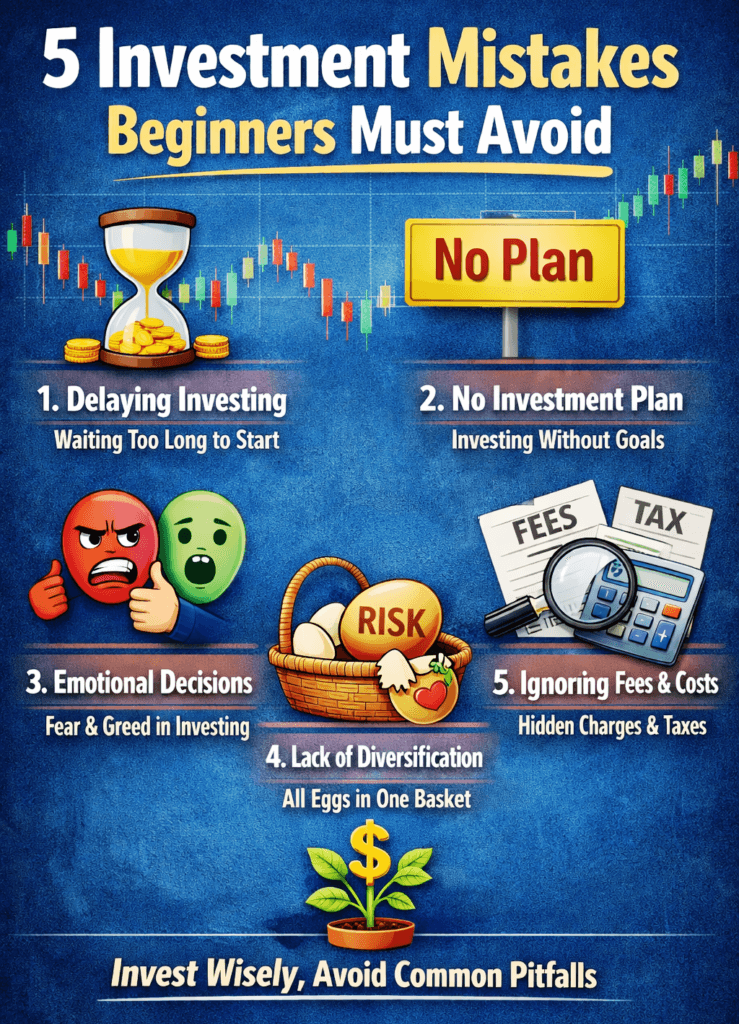
1. Not Starting to Invest Early (Procrastination)
One of the biggest mistakes for any beginner is not investing at all keeping money sitting in cash or low-yield savings because of hesitation or procrastination. The truth is that the worst investment error is never starting. Every day you delay investing is a day you miss out on potential growth from compound interest. Over time, those missed days can add up to a significant opportunity cost in lost wealth. According to financial experts, the single largest mistake beginners make isn’t picking the wrong stocks it’s failing to get started investing in the first place. Money left idle in a bank (or under the mattress) will barely keep up with inflation, whereas money put into prudent investments can grow substantially over the years.
Starting early is vital because of compound growth the process of earning returns on top of previous returns. Even small amounts invested regularly can snowball into large sums given enough time. “A small amount makes a big difference long term,” notes Jack Heintzelman, a director of wealth management, emphasizing those even modest contributions (like $50 or $100 a month) can greatly boost your wealth over decades. Beginners often mistakenly believe they need a lot of money or that they should wait for the “perfect” time to start.
In reality, time in the market is more important than timing the market. The sooner you begin investing, the more you harness the power of compounding to work in your favor. Don’t let fear or lack of knowledge paralyze you into inaction start with an amount you can afford, and gradually increase contributions as you learn. The key is to stop procrastinating and get your money working for you as early as possible.
2. Investing Without a Plan or Clear Goals
Another major rookie mistake is jumping into investing without an investment plan. If you don’t have a clear strategy that outlines your goals, timeline, and risk tolerance, it’s easy to make impulsive moves or end up in investments that aren’t right for you. Beginners who invest haphazardly perhaps buying stocks on a hot tip or following what friends are doing often find themselves taking on too much risk or holding assets that don’t align with their needs. “Without an investment plan that identifies your goals, it’s easy to overreact, invest reactively, or underestimate risk,” says certified financial planner Nathan Sebesta. For example, someone with no plan might put a large chunk of money into a trendy, volatile stock without realizing it’s more risk than they can reasonably handle.
In contrast, successful investors develop a plan that considers their objectives (why they’re investing), time horizon (how long before they need the money), and risk tolerance (how much volatility they can stomach). Investors who map out these factors are better positioned to achieve their goals than those flying blind. As a beginner, take the time to determine what you’re investing for, be it retirement, a home purchase, or another goal and choose an appropriate strategy.
Your plan should also include basic financial groundwork: ensure you have an emergency fund for unexpected expenses and high-interest debts under control before locking money into investments. Otherwise, you might be forced to pull out investments at a bad time to cover a surprise bill. Remember that investing should be done with money you won’t need in the immediate future, so you can leave it to grow. By defining a clear plan and sticking to it, you’ll avoid reactive decisions and choose investments that fit your long-term strategy rather than chasing the flavor of the month.
3. Letting Emotions Drive Your Decisions (Fear and Greed)
Emotional investing buying or selling based on fear, greed, or herd mentality is a classic beginner mistake that can wreck your returns. Markets naturally rise and fall, but new investors often feel panicked during a downturn and overly euphoric during a boom. Acting on these emotions typically leads to buying high and selling low, the exact opposite of a sound strategy. When stock prices plunge and headlines scream about market crashes, it’s natural to feel anxious and want to sell everything to cut losses.
However, history shows that panic selling often happens at exactly the wrong time when prices are low and a recovery is likely around the corner. Likewise, when everyone is buzzing about winning stocks or the latest hot investment, the fear of missing out (FOMO) can push beginners to buy into a rally at its peak without proper research. These emotion-driven moves can result in heavy losses or missed gains.
Trying to time the market is another form of emotional investing that beginners should avoid. It’s tempting to think you can hop in and out of the market to avoid downturns and catch rallies, but even experts struggle to do this reliably. “Attempting to time the market… is nearly impossible to do consistently,” warns financial author Kevin Matthews II, because you’d have to correctly predict when to get out, what to buy next, and when to get back in an almost impossible triple feat. Missing just one of those steps can drastically hurt your portfolio.
In fact, studies show that if an investor missed only the 5 best days in the stock market since 1988, their long-term returns would be 37% lower than staying invested throughout. Similarly, a 2024 analysis found the average stock investor underperformed the S&P 500 by 8.48% (848 basis points) because of bad market timing and late re-entries essentially, emotional decisions caused them to miss out on gains. These findings underscore that jumping in and out of investments due to short-term feelings is a recipe for underperformance.
The solution is to cultivate discipline and a long-term perspective. Avoid making rash decisions when you see short-term losses. Instead of reacting to every market dip or hype cycle, stick to your plan (as discussed above) and remember that investing is a “get rich slowly” process. Consider setting up automatic investments on a regular schedule (a strategy known as dollar-cost averaging) so you continue investing in both good and bad markets without letting fear or greed dictate your timing. Also, try to tune out the noise checking your portfolio too often or obsessing over news can trigger emotional trades. By keeping your cool and focusing on fundamentals, you’ll avoid the common trap of letting emotions sabotage your investment success.
4. Not Diversifying Your Portfolio
“Don’t put all your eggs in one basket” may be a cliché, but it’s critical advice for beginners. Lack of diversification is a mistake that can dramatically increase the risk of losing money. Some new investors will buy a handful of stocks in companies they know (say, a couple of big tech stocks) and assume that’s sufficient. However, any individual company can suffer unforeseen problems from new competitors to management scandals that tank its stock price. If your money is concentrated in just a few picks, your portfolio could be devastated by one company’s misfortune. As financial planner Luke Harder notes, many beginners invest in a few well-known stocks and simply hope for the best, not realizing that even strong companies are exposed to specific risks that could hurt their business. Diversification means spreading your investments across many assets so that no single loss can irreparably harm your wealth.
The easiest way for beginners to diversify is by using funds such as mutual funds or exchange-traded funds (ETFs) that hold hundreds or even thousands of different stocks or bonds. This automatically gives you a broad mix of investments, reducing the impact if any one holding performs poorly. Instead of trying to pick the one next Amazon or Apple (which is very hard to do), you’re effectively betting on the market’s long-term growth as a whole, a strategy that has historically been more reliable for building wealth.
Diversification isn’t just about holding many stocks; it also means considering different sectors (technology, healthcare, finance, etc.), and even different asset classes (stocks, bonds, real estate, etc.) appropriate for your goals. A well-diversified portfolio might include U.S. and international stocks, large and small companies, and some fixed-income or other assets to balance things out. The benefit is that when some investments are down, others may be up smoothing out the ride and reducing overall volatility in your portfolio. This is especially important for beginners, as it prevents the shock of a huge loss from one bet gone wrong.
Practically, avoid the mistake of going “all in” on a single stock, sector, or cryptocurrency that’s popular at the moment. No matter how confident you are, spread your risk. Use low-cost index funds or ETFs to cover broad swaths of the market, and don’t chase flashy opportunities with all your money. Diversification might not be exciting you won’t double your money overnight but it shields you from catastrophic outcomes and sets you up for steady, sustainable growth. Over the long run, a diversified approach will help you avoid losing money due to a single investment’s collapse, giving you a more stable path to reach your financial goals.
5. Neglecting Fees and Hidden Costs (and Taxes)
Beginner investors often focus on picking investments but forget that the cost of those investments can eat into their returns. Ignoring fees and other investing costs is a mistake that can silently erode your wealth over time. Many mutual funds and exchange-traded funds charge an annual management fee (expressed as an expense ratio), and some investment accounts come with administrative fees or trading commissions. These percentages may seem small, but they compound over years. As an example, an expense ratio above ~0.4% is considered on the high side and plenty of actively managed funds charge 1% or more. Paying an extra 1% in fees annually might sound minor, but over 20 or 30 years it can cost you tens of thousands of dollars in foregone returns. Newer investors sometimes overlook how expenses and taxes add up later, which can seriously cut into the net gains they actually keep.
To avoid this mistake, always check the fees on your investments. Opt for low-cost index funds and ETFs when possible many have expense ratios well under 0.2%, saving you money compared to pricey funds. If you’re using a brokerage or robo-advisor, understand their fee structure. Even frequent trading can incur costs (spreads, potential commissions, or tax impacts) that weigh down performance. Besides fees, be mindful of taxes, which are another cost to manage. For U.S. investors, taking advantage of tax-advantaged accounts like a 401(k) or IRA can make a big difference.
Money invested in a traditional 401(k) or IRA can grow tax-deferred until retirement, meaning more of your money stays invested and compounds instead of being siphoned off by annual taxes. Young investors especially can benefit from accounts like a Roth IRA, where you contribute after-tax dollars but all future growth is tax-free decades of tax-free compounding can dramatically boost long-term wealth. European and other international investors often have equivalent tax-efficient vehicles or allowances; make sure you’re making use of any tax shelters or incentives available in your country.
In short, be cost-conscious with investing. A beginner might not realize that two funds aiming to do the same thing (say, track the S&P 500) can have vastly different fees and the higher-cost one will consistently drag on your returns. Similarly, making unneeded withdrawals or not considering tax implications can result in losing money to the government that you could have saved with proper planning. By choosing low-cost investments and investing in a tax-efficient way, you’ll keep more of your money working for you. Remember, every dollar saved in fees or taxes is a dollar added to your investment returns. Over the long run, minimizing these costs can mean the difference between reaching your financial goals and falling short.
Conclusion
For beginner investors, success isn’t about finding a secret trick or taking big gambles it’s about consistently making good choices and avoiding the missteps that derail so many novices. The five mistakes outlined above failing to start early, investing without a plan, succumbing to emotions, lack of diversification, and neglecting costs are all pitfalls that can cause beginners to lose money unnecessarily. The encouraging news is that each of these mistakes is entirely avoidable with knowledge and discipline. Smart investing is not about chasing hot tips or reacting to every market swing; it’s about staying focused on your goals, making informed decisions, and building good habits over time. Always keep your strategy simple and grounded in the fundamentals.
By starting to invest as soon as you can, crafting a clear plan (and sticking to it), keeping your emotions in check, spreading out your investments, and watching what you pay, you set yourself up for steady growth and financial security. Investing is indeed a long-term journey a “get rich slowly” endeavor and avoiding these beginner mistakes will help ensure that you reap the rewards of that journey rather than stumble along the way. Stay educated, remain patient, and remember that the goal is to build wealth over years and decades, not overnight. If you’re ever unsure about your decisions, don’t hesitate to seek advice from reputable sources or financial professionals. By sidestepping these common investment errors and following proven investing tips, even a beginner can invest with confidence and avoid losing money needlessly, paving the path toward a brighter financial future.
Financial Disclaimer
The information provided on this blog is for educational and informational purposes only and should not be considered financial, investment, tax, or legal advice. All content is general in nature and may not apply to your individual circumstances.
While we strive to keep the information accurate and up to date, we make no warranties or guarantees regarding completeness, reliability, or accuracy. Any actions you take based on the information on this blog are strictly at your own risk.
Before making any financial decisions, you should consult a qualified professional who can consider your specific goals, income, risks, and personal situation.
Frequently Asked Questions
What are the most common beginner investment mistakes?
The most common beginner investment mistakes are delaying investing, investing without a plan, emotional buying/selling, lack of diversification, and ignoring fees and taxes.
Why is starting early so important in investing?
Starting early gives your money more time to grow through compounding. Even small, consistent contributions can become significant over 10 to 30 years.
How do I create a simple investment plan as a beginner?
A basic plan includes: your goal (retirement, home, education), time horizon, risk tolerance, monthly amount you can invest, and the asset mix you’ll follow (e.g., diversified index funds).
Is it bad to invest when the market is high?
It depends on your timeline. For long-term goals, investing steadily is usually better than waiting for the “perfect” time. Trying to time the market often leads to missed opportunities.
How much diversification do beginners need?
Enough that no single stock, sector, or asset can seriously damage your portfolio. Many beginners use broad index funds or ETFs because they spread risk across many companies.
Are index funds and ETFs good for beginners?
Yes. They’re typically diversified, low-cost, and easier to manage than picking individual stocks, making them a common starting point for new investors.
What investment fees should I watch out for?
Key costs include expense ratios (fund fees), trading commissions (if applicable), account management fees, and spreads. Over time, high fees can significantly reduce your returns.
How do taxes affect beginner investors in the U.S. and Europe?
Taxes can reduce net returns, especially if you trade frequently. In the U.S., accounts like 401(k)s and IRAs can reduce taxes. In Europe, many countries have tax-advantaged accounts or allowances check local rules.
Is it risky to invest in individual stocks as a beginner?
It can be. Individual stocks carry company-specific risk. If you invest in single stocks, limit position size and keep most of your money in diversified funds.
What is the safest way for a beginner to start investing?
A common approach is: build an emergency fund, pay off high-interest debt, then invest regularly into diversified, low-cost funds using a long-term plan.