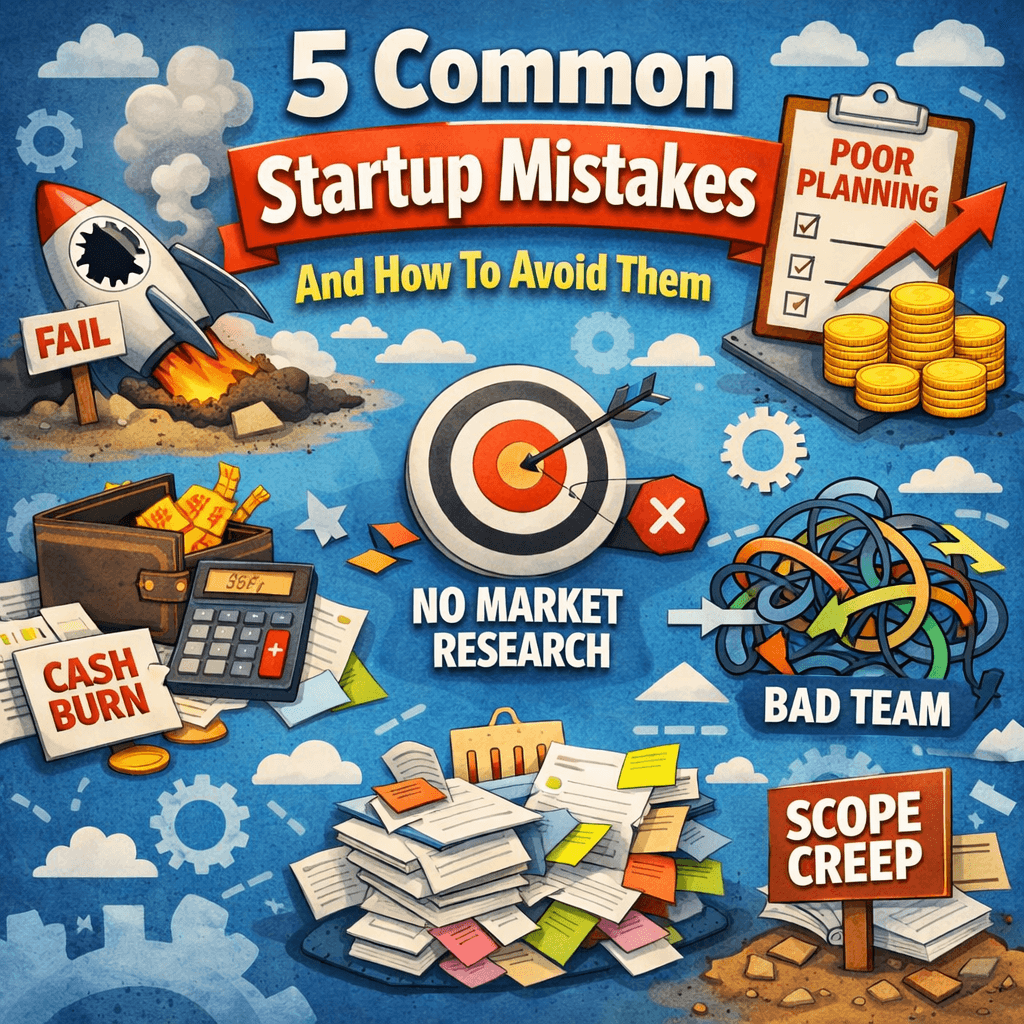
Launching a startup is exciting and risky in equal measure. The U.S. Bureau of Labor Statistics estimates that roughly two out of ten businesses fail within their first year. Although some factors are outside a founder’s control, many early failures can be traced to avoidable mistakes. By understanding these pitfalls and building strategies to sidestep them, entrepreneurs improve their odds of survival.
This in‑depth guide identifies five of the most common missteps and offers practical advice for avoiding them. Each section draws on insights from entrepreneurship experts, data from recent studies and stories from successful startups. If you’re planning to start your own venture or are looking to course‑correct an existing one, read on to learn how to set a solid foundation.
Mistake 1: Skipping Market Research and Product‑Market Fit
Among the top reasons startups fail is a simple but devastating oversight: building a product that nobody wants. Paul Graham, co‑founder of Y Combinator, famously noted that all startup failures boil down to “not making something users want”. That inability often stems from inadequate market research and poor validation of assumptions.
The U.S. Chamber of Commerce’s CO business portal warns that many founders underestimate their market’s competitiveness because they don’t spend enough time understanding their target customers. Without research, startups launch products based on internal opinions rather than real customer pain points. The University Lab Partners accelerator has also seen founders skip market validation. In one example, companies poured capital into developing a minimum viable product (MVP) only to discover late in the process that nobody actually needed it. The team emphasises that successful ventures validate market need before spending heavily; they test early prototypes with customers, gather feedback, refine the value proposition and only then raise additional capital.
How to avoid this mistake
- Conduct comprehensive market research. Identify the size of your target market, existing competitors and customer segments. Use surveys, interviews and public data to learn about unsolved problems and willingness to pay. For example, University Lab Partners recommends performing voice of customer interviews and SWOT analyses to assess strengths, weaknesses, opportunities and threats.
- Validate demand before scaling. Develop inexpensive prototypes or landing pages to test hypotheses. Release an MVP to early adopters and collect actionable feedback on features and pricing. ULP notes that validating the market need early minimises risk and helps identify real customers.
- Iterate quickly. Use lean startup principles: build, measure, learn. If user feedback shows your idea solves the wrong problem, pivot. As Graham points out, successful startups often end up doing something very different from their original idea. Openness to change is critical.
- Differentiate your value proposition. Avoid launching derivative products that imitate existing companies. Graham observes that many applicants to Y Combinator present “derivative ideas” that solve no unique problem. Instead, find unsolved problems or new angles on existing markets.
Mistake 2: Poor Financial Management and Cash‑Flow Oversight
Another common failure point is running out of money. A startup can be profitable on paper yet collapse if cash doesn’t arrive soon enough to pay expenses. A Forbes analysis of early‑stage ventures highlights that ignoring cash flow is a critical error; a company may run out of money even when revenue projections look healthy if cash isn’t flowing in fast enough to cover costs. Startups should review cash‑flow forecasts monthly and keep enough runway to survive unexpected setbacks.
Overspending on unnecessary tools can also drain finances. According to U.S. Chamber of Commerce, small businesses often invest in too many software products; the average company uses 16 HR and payroll tools, which burdens budgets and complicates workflows. Consolidating the tech stack onto a single platform can yield significant cost savings.
Finally, disorganised bookkeeping creates a blind spot. The U.S. Chamber of Commerce warns that startups risk misunderstanding cash flow, making unwise decisions and facing tax compliance issues when they lack proper accounting systems. Without accurate financial records, founders can’t track profitability, plan for taxes or satisfy investors.
How to avoid this mistake
- Build a detailed budget and monitor burn rate. Estimate monthly expenses realistically and compare them against conservative, realistic and optimistic revenue scenarios. Forbes advises founders to set a burn rate that provides 12 to 18 months of runway and adjust spending based on performance metrics.
- Prioritise cash‑flow management. Track inflows and outflows weekly or monthly. Use financial dashboards or tools like QuickBooks or startup‑focused platforms to monitor runway, cash conversion cycles and cost drivers. Forecast multiple scenarios to prepare for best‑case and worst‑case outcomes.
- Avoid excessive overhead. Be frugal with office space and non‑essential perks. Forbes notes that spending heavily on fancy offices can drain resources. Remote or hybrid models allow you to allocate funds toward product development and customer acquisition.
- Consolidate your tech stack. Choose integrated software that handles multiple functions. Reducing the number of separate tools simplifies processes and saves money.
- Keep accurate books and hire experts when needed. Use accounting software to record transactions and generate invoices, or hire a part‑time bookkeeper. The U.S. Chamber of Commerce recommends outsourcing if you lack accounting knowledge and notes that organised financial records are vital for tracking profit, cash flow and tax compliance.
Mistake 3: Weak or Misaligned Team
Startups often underestimate the importance of team composition. Y Combinator co‑founder Paul Graham points out that having a single founder is risky. Being a sole founder suggests you couldn’t convince anyone to join your vision, and it leaves you without colleagues to brainstorm with, challenge assumptions or offer emotional support during low periods. Even companies that appear to have one founder usually have more partners behind the scenes.
University Lab Partners echoes this sentiment, stressing that a CEO’s main job is to lead the company rather than to do all the technical work. Founders who excel at engineering or research might not be suited for running a business; investors often bet on leadership as much as on the idea. A strong CEO must develop a compelling vision, execute strategy, set goals and attract advisors.
Beyond the chief executive, startups need diverse skill sets. ULP lists critical roles such as chief technology officer, sales and marketing leads, chief financial officer and legal/regulatory advisors. Some positions can be advisory, but the core team should cover technology, product, finance and customer acquisition.
How to avoid this mistake
- Find complementary co‑founders. Look for partners who bring skills you lack. If you’re a technical founder, team up with someone who understands marketing, sales or operations. Having at least one co‑founder provides emotional support, accountability and extra brainpower to solve problems.
- Hire for culture and capability. Recruit people who believe in your vision and can adapt to a startup environment. Remember that bad hires can kill companies; Graham warns that in the 1990s many e‑commerce startups failed because business‑minded founders hired programmers who couldn’t deliver.
- Build an advisory board. ULP recommends assembling 3 to 6 engaged advisors with diverse skills to fill gaps in expertise. Advisors can provide accountability and help the management team make disciplined decisions.
- Clarify roles and responsibilities. Define who handles product development, customer acquisition, finance, legal and regulatory issues. Fuzzy roles lead to duplication of effort and missed tasks.
- Invest in leadership development. Encourage founders to hone their leadership skills. A capable CEO must set vision, execute strategy, manage cash and hold the team accountable.
Mistake 4: Neglecting Cybersecurity and Risk Management
Startups are sometimes tempted to put all their resources into product development, leaving cybersecurity for later. Jason Manar, a former FBI agent and chief information security officer, warns that companies that ignore cybersecurity to save money expose themselves to costly breaches. The average cost of a data breach for U.S. businesses reached nearly US$9.5 million in 2023, a sum that can easily sink an early‑stage startup.
Manar and other experts emphasise that cyber threats aren’t an optional concern for small companies. An incident can lead to legal liabilities, reputational damage, customer churn and regulatory fines. Startups often collect sensitive customer information (e.g., emails, payment data) without robust security controls. Cybercriminals view small businesses as easy targets because they typically invest less in protection.
How to avoid this mistake
- Develop a cybersecurity strategy early. Allocate part of your budget to security from day one. Identify the data you collect and store (customer information, intellectual property, employee records) and implement controls to protect it.
- Educate your team. Manar stresses that startups should train employees on best practices and security awareness. Many breaches begin with phishing emails or weak passwords. Regular training reduces risk.
- Create an incident response plan. Prepare for worst‑case scenarios by writing a plan that outlines how to detect, report and contain cyber incidents. Ensure each employee knows their responsibilities in the event of a breach.
- Choose secure tools and vendors. Use cloud services and software providers that comply with security standards such as SOC 2 or ISO 27001. Evaluate vendors carefully before integrating them into your infrastructure.
- Stay current with regulations. Understand legal requirements for data privacy in your jurisdiction (e.g., GDPR, California’s CCPA). Non‑compliance can result in fines or lawsuits.
Mistake 5: Refusing to Adapt or Pivot
Flexibility is a hallmark of successful startups. Yet some founders cling stubbornly to their original vision even when evidence shows it’s wrong. Paul Graham calls this mistake obstinacy. He explains that startups resemble scientific research more than goal‑pursuit sports; founders must follow the trail wherever it leads. Most successful companies evolve into something different from what they initially imagined, and the hardest part is discarding the original idea when it isn’t working.
The U.S. Chamber of Commerce article also notes that startups, particularly in technology, often fail because they don’t adapt to industry changes. Markets evolve rapidly; customer needs shift and new competitors emerge. A rigid business model may become obsolete in months.
How to avoid this mistake
- Track customer feedback and metrics continuously. Listen to your users’ complaints and measure engagement, retention and revenue. Data should guide decisions; ignore vanity metrics that don’t indicate real traction.
- Be willing to pivot. If experiments show your product doesn’t solve a meaningful problem, iterate or change direction. Graham suggests asking whether users are excited about the new direction; if so, pivoting is likely wise.
- Maintain strategic flexibility. Set high‑level goals but remain open to adjusting tactics. Businesses that treat their plans as hypotheses rather than immutable roadmaps can respond quickly to changes.
- Learn from competitors and industry trends. Keep abreast of new technologies, regulations and customer preferences. The U.S. Chamber of Commerce article emphasises that staying aligned with the fast‑paced business world requires realigning goals when markets shift.
- Balance conviction with humility. Believe in your mission, but accept that your current product or model may need to change. Overconfidence can blind founders to emerging opportunities or threats.
Conclusion
Starting a company is difficult, but many of the pitfalls are predictable. Avoid building products that nobody wants by conducting thorough market research and validating demand. Protect your cash by budgeting realistically, monitoring burn rate and keeping clean books. Assemble a strong, complementary team instead of trying to go it alone. Invest in cybersecurity to prevent expensive breaches. Finally, be ready to adjust your plan when the market or your customers tell you to.
By recognising these common mistakes, entrepreneurs can set more realistic expectations and build organisations that are resilient, adaptable and positioned for long‑term success. Each company’s journey is unique, but the underlying principles of listening to customers, managing finances prudently, cultivating the right team, protecting assets and staying flexible apply universally. Use the lessons highlighted here as a blueprint to steer your startup away from common hazards and toward sustainable growth.
Financial Disclaimer
The information provided on this blog is for educational and informational purposes only and should not be considered financial, investment, tax, or legal advice. All content is general in nature and may not apply to your individual circumstances.
While we strive to keep the information accurate and up to date, we make no warranties or guarantees regarding completeness, reliability, or accuracy. Any actions you take based on the information on this blog are strictly at your own risk.
Before making any financial decisions, you should consult a qualified professional who can consider your specific goals, income, risks, and personal situation.
Frequently Asked Questions
What are the most common startup mistakes?
The most frequent mistakes include skipping market validation, mismanaging cash flow, hiring the wrong team too early (or too late), ignoring basic cybersecurity, and failing to adapt when customers and the market signal a change is needed.
How can I validate my startup idea before building the product?
Start with customer discovery interviews, problem validation, competitor research, and willingness-to-pay tests. Use landing pages, waitlists, concierge pilots, or pre-orders to validate demand before investing heavily in engineering.
What’s the difference between “market research” and “validation”?
Market research helps you understand the landscape (customers, competitors, pricing, trends). Validation proves through evidence that your specific offer solves a problem and that target users will adopt or pay.
What early metrics matter most for avoiding product-market failure?
Focus on: activation (users reaching the “aha” moment), retention (do they come back), churn reasons (why they leave), and time-to-value (how fast they get results). For B2B, pipeline quality and renewal intent are also critical.
How do startups typically run out of money even when sales look good?
Because cash timing matters. You can be “profitable on paper” but still fail if invoices are paid late, costs are upfront, or you scale headcount and marketing faster than cash comes in.
What is burn rate and runway, and what’s a healthy target?
Burn rate is how much cash you spend per month (net). Runway is how many months you can operate at your current burn. Many founders aim for enough runway to handle setbacks and still execute key milestones without panic decisions.
How can I improve cash flow management in the first year?
Maintain a simple monthly cash forecast, review it consistently, cut nonessential recurring costs, negotiate better payment terms, and tie spending to measurable milestones (e.g., acquisition targets, product releases, revenue goals).
When should I start hiring, and who should be first?
Hire when there is a clear, repeatable need tied to growth or delivery. Early hires should directly impact product quality, customer outcomes, or revenue generation. Avoid “nice-to-have” roles until your core engine is working.
Is it okay to be a solo founder?
It can work, but it often increases execution and resilience risk because startups require breadth, speed, and emotional endurance. If you’re solo, compensate by building a strong advisory network, accountability mechanisms, and complementary contractors or early leaders.
What’s the fastest way to reduce startup risk?
Validate demand early, keep spending disciplined, measure what matters (retention and cash), and build a small team that can execute quickly. The combination of evidence-based product decisions and financial discipline is the biggest risk reducer.
What’s a practical checklist to avoid these mistakes weekly?
Review customer feedback and retention signals, update cash/runway forecasts, audit the next two hires (if any) for ROI and role clarity, confirm security hygiene (MFA/access), and decide what you’ll stop doing based on market signals.